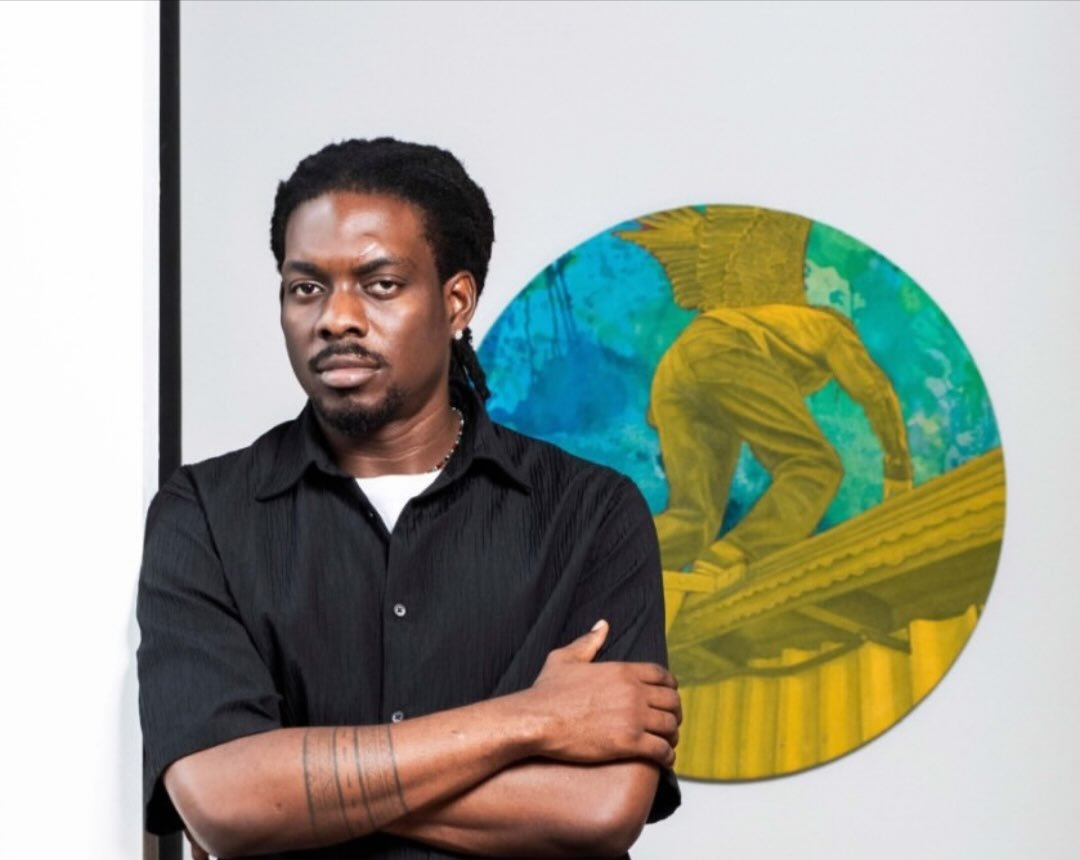

Fortune Ibeh
There is a moment in almost every Ken Nwadiogbu work when the illusion gives way. A figure begins to dissolve, a body breaks apart, colour takes over the canvas, and somewhere within it all, an eye looks back at you. Rendered with almost photographic precision, it has become one of the most recognisable elements of Nwadiogbu’s practice. But the eye is more than a signature. It is the thread connecting a body of work concerned with visibility, identity, memory and what it means to really look at another person.

The story behind it is deeply personal. As a child in Lagos, Nwadiogbu injured his eye while playing with his brother, tearing it on a door handle and undergoing stitches while still awake.
The experience stayed with him. So did his mother’s words that the eye is a gateway to the world. Years later, that childhood injury would become one of the defining ideas in his art, turning something that once made him self-conscious into a way of looking more closely at the world around him.

Nwadiogbu did not begin with plans to become an artist. Born in Lagos in 1994, he studied civil and environmental engineering at the University of Lagos while developing his art independently. His early charcoal drawings gained attention for their hyperrealism, often appearing so photographic that the distinction between drawing and photograph became almost irrelevant. But Nwadiogbu was never interested in realism simply as a technical feat.

He wanted the image to carry something beyond what could immediately be seen.
That thinking eventually became Contemporealism, his approach to combining hyperrealism with contemporary social and cultural ideas. His figures are often fragmented, obscured or interrupted, creating space for conversations around migration, displacement, Black identity, African culture and visibility. The realism draws you in, but the disruption asks you to stay longer. His recurring eye becomes the point of connection, confronting the viewer while giving his subjects a sense of presence that refuses to be overlooked.


His practice has continued to expand with him. Since his solo debut, A Different Perspective, in 2022, Nwadiogbu has taken his work from Lagos and Abuja into galleries and cultural spaces in London, Berlin and the United States.

His work has appeared at places including Somerset House and Saatchi Gallery, while collaborations and commissions have pushed his visual language beyond the conventional gallery setting.
He has also explored materials such as Akwete cloth, bringing his contemporary figures into conversation with histories and traditions embedded in Nigerian craft.There has been an equally visible shift in the work itself. After moving to London to study painting at the Royal College of Art, Nwadiogbu began moving beyond the monochromatic restraint of his early charcoal work. Rich reds, oranges and yellows now sit alongside his familiar figures, creating paintings that feel more atmospheric and emotionally charged. The change has not abandoned the questions at the heart of his practice. If anything, the colour has given those questions another language.

The recognition has followed. In 2025, Nwadiogbu received the Royal Society of British Artists’ Rising Star Award, before winning the Young Generation Art Award in Berlin in 2026 from a field of almost 400 applicants. Yet his trajectory remains tied to the creative community he came from. Through initiatives including Artists Connect NG and Title Deed, he continues to create spaces for emerging artists in Nigeria. For an artist whose work is so concerned with being seen, perhaps that is the most fitting extension of his practice: looking back, and making sure others have a chance to be seen too.