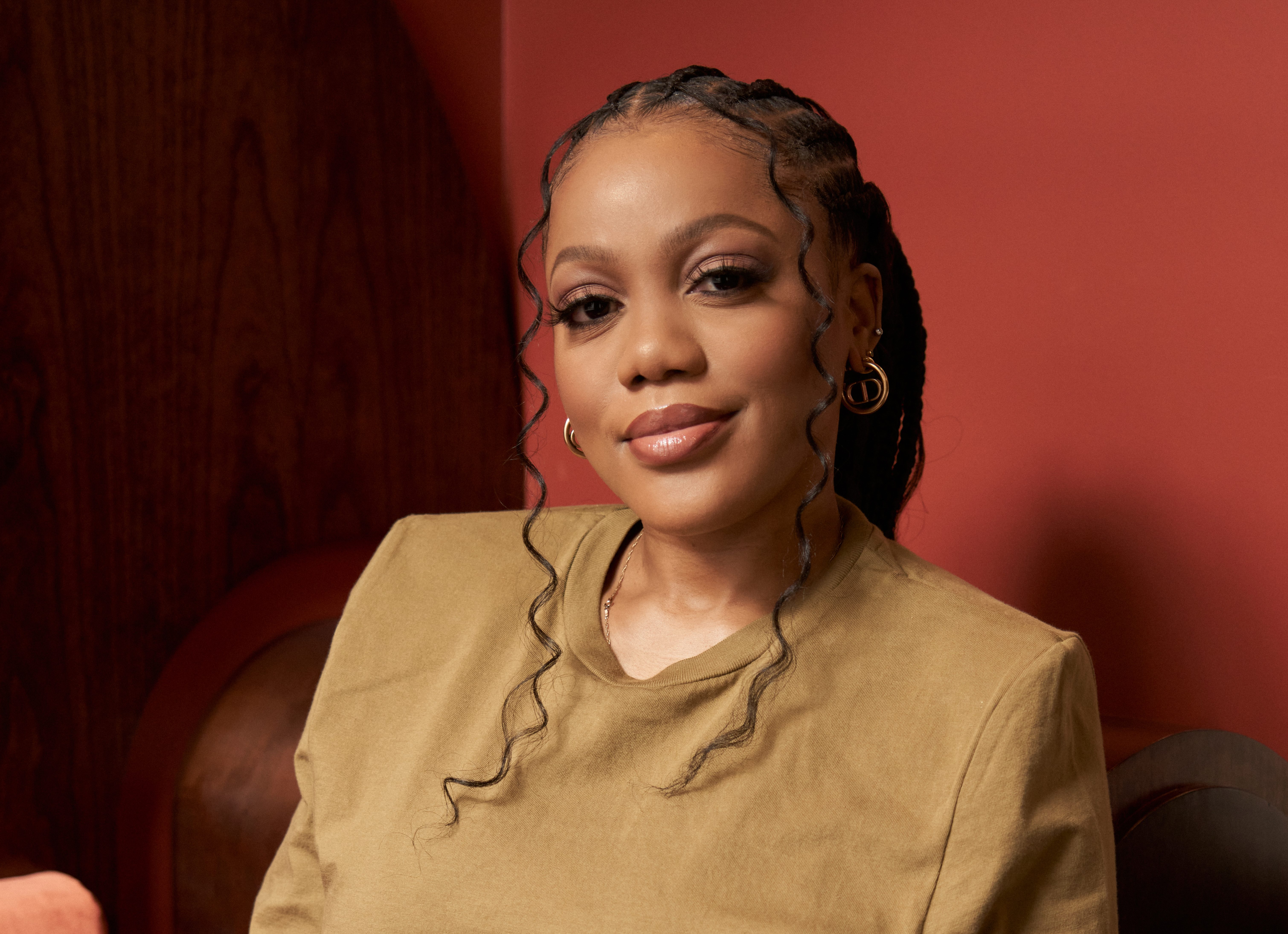
Audacity, God, and the Quiet Confidence of Elizabeth Sobowale
Written by Oluwanisola Akintola.

When the team suggested Elizabeth Sobowale for our International Women’s Day feature ( In Recognition Of Her Work) , I realised something almost immediately: I knew her name, but I didn’t really know the story behind it.
International Women’s Day is one of the few moments in the year dedicated to celebrating women. But when the idea for the campaign first came up, I knew I didn’t want to celebrate women in the abstract simply. I wanted to celebrate their work — especially the women working behind the scenes. I wanted someone who would not only inspire me today, but someone who would have inspired me when I was 15, and who could still inspire other 15-year-olds now.
Elizabeth Sobowale felt like the perfect person for that. At the time, I didn’t know much about her, which only made me more curious.
After some in-depth research, I discovered three things. First, she has a powerful story. Second, this is a woman who does not take no for an answer. And third — I dare you to cross her path.
Watching her past interviews and reading more about her work, I already felt a surge of inspiration. Still, none of that quite prepared me for how impressive she is in real life.

I remember our conversation vividly. Even though it was an evening call on Google Meet, I found myself nodding along to everything she said.
One thing that stood out immediately was her faith. It is not something she performs or speaks about lightly. It sits quietly at the centre of how she lives and works. You can tell that before the ambition, the achievements, and the many things she has built, there is a deep faith guiding how she moves through the world.
We started the interview with a simple question: How was your day? It felt like an easy place to begin, something that might help us settle into the conversation, although if I’m being honest, it was probably more for me than for her.
Her reply immediately gave a glimpse into the rhythm of her life.
“I always say I have two days in 1. My day starts at around 5 AM when I’m in the US. By the time the UK is closing for the day, another day is starting for me in the US. But yeah, my day is going well. I’m midway here in the US.”
For context, the interview started at 5:30 p.m. UK time, which meant that while I was approaching the end of my day, Elizabeth was only halfway through hers. Even in that small moment, it became clear that the pace of her life moves across time zones, responsibilities, and continents.
What followed was a conversation about persistence, purpose, faith, and the kind of work that often happens quietly behind the scenes but changes things in real ways. In our conversation, Elizabeth spoke about her journey, the challenges she has faced, and the discipline it takes to keep showing up for work.
The Conversation:
In your recent Instagram caption, you described yourself as “a stubbornSàgámù girl with a lot of audacity from God.” Why was it important for you to describe yourself that way?
When people ask where I’m from, I always say Sàgámù. Anyone who has ever had that conversation with me will hear the same answer: I’m from Sagamu. People often wonder why.
Although I have lived most of my life in the UK, I grew up in Sàgámù until I was about eleven. I never actually lived in Lagos. I visited from time to time, but Sàgámù is where my childhood really happened.
Those were my formative years. That was where I learned grit and discipline. Moving to the UK didn’t shape who I became as much as growing up in Sàgámù did.
That caption represents who I am. The “stubborn” part is because I don’t accept no, I don’t accept defeat, and I never believe anything is impossible for me to achieve. Sàgámù is my identity. It’s what formed me.
And then God, because that is everything. God comes first, before anything else in my life.
When Elizabeth speaks about Sàgámù, it becomes clear that the foundation of who she is today was formed there. Sagamu in Ogun State sits between Lagos and Ibadan and is known as the cultural home of the Remo people in Nigeria.
She recalls being around school life long before she officially became a student. The school itself was run by a former military officer ( a family friend) whose strict discipline shaped the environment she grew up in.
Her days started as early as 5 a.m., even at a very young age. Expectations were high, and discipline was not optional. Because of the close relationship between the school and her family, she often felt an even greater pressure to show up.
“I didn’t really have the chance to be anything but first in my class every term,” she says.
There was only one time she remembers falling short. After missing school for several months following the death of her uncle, she returned and finished fifth in her class. The experience stayed with her and strengthened her determination never to fall behind.
Looking back, Elizabeth credits much of her discipline not only to those early school years but also to her parents, especially her father. A highly structured and organised engineer, he received a scholarship at the age of eight to travel from Sàgámù to the United Kingdom to continue his education. His focus, intelligence, and punctuality later became the example that shaped her own work ethic.
For Elizabeth, those early years in Sàgámù were more than childhood memories. They were the training ground for the discipline, resilience, and ambition that define the woman she has become today.
Elizabeth speaks about failure with the calmness of someone who has already made peace with it.
A moment that once felt like failure but later became an important lesson in resilience. Rather than seeing things not going according to plan as defeat, she now sees them as moments to reassess and try again.
As she puts it, “It’s not about trying once. It’s about how much you want it and what you’re willing to do to get there.”
For Elizabeth, persistence matters more than perfection. The world changes constantly, and strategies that worked yesterday may not work tomorrow. When things don’t go as planned, she simply returns to the drawing board, rethinks her approach, and finds another way forward.

Growing up Nigerian, many of us were told we could become lawyers, doctors, engineers, or entrepreneurs. Music entrepreneurship wasn’t presented as a clear career path. How did you realise this was something you wanted to pursue?
I never actually planned to pursue this. I never saw myself in the music industry. Growing up, I always thought I would become a journalist. I wanted to read the news, write the news, do investigative research, and travel around the world reporting on current affairs and wars. I wanted to be the person on television asking politicians difficult questions about why they weren’t doing their jobs properly.
My mum used to beg me not to do it. She would say, “Do you really have to do this kind of work? They will kill you.”Elizabeth laughs.
As I got older and moved to the UK, I began to notice that there was no one on television who looked like me or spoke like me. That made me question whether that path would work for me. So I pivoted slightly. I still wanted to be a journalist, but I started thinking more about writing rather than being on television.
I went on to study English Language and Communication at the University of Hertfordshire, alongside modules in media, sociology, and psychology. My career advisor suggested that
Instead of doing a journalism degree, I should study something broader so I wouldn’t limit my options if I ever decided to change direction.
While I was at university, I worked at a coffee shop in a train station. One of the regular customers noticed that I was always reading and asked me one day, “You don’t look like you want to be here.”
I told him of course I didn’t. I was eighteen, working in a coffee shop, and I knew I didn’t want to do that for the rest of my life.
He started asking me what I was reading, and every time he passed by I would show him the book I had with me. Eventually he gave me his business card and told me to email him about whatever I was reading at the time. One day he invited me to his office in London. When I arrived, I realised he had arranged an interview for me at his PR agency, which focused on events.
After the interview, they asked me to write a press release. Because of my interest in journalism and everything I had been reading about branding and marketing, I knew how to write one. I ended up getting the internship.
During that internship I met a lot of people in the industry. That was where I met my first client, Cuppy, at one of the events. We stayed in touch, and when we were both turning twenty-one and leaving school, she asked me to come on board and work with her.
At the time, the person managing her had hired me as his assistant, but he left about three months later. When he left, I told her I could manage her because I had already been doing most of the work anyway. She agreed.
We were both twenty-one and, honestly, we didn’t fully know what we were doing. But we had the courage to try.
That was my way into the music industry. I simply asked for the opportunity, and everything I know now I learned along the way.
That phrase — “I just asked” — paired with her refusal to take no for an answer, is what I believe has shaped Elizabeth Sobowale into the woman and industry force she is today.
Over the years, Elizabeth has worked with several major names in the creative industry, including Pheelz, Mr Eazi, and Cuppy, among many others, through advocacy, consulting, and management. Today, many people know her best for managing Adekunle Gold.
For her working on the logistics and business side of the music industry felt almost natural.
“I don’t sing,” she says with a laugh. “If I wanted to be a producer, I might even be good at it. Funny enough, I can write lyrics.”
Her strength, she explains, lies in storytelling.
“I know how to weave stories together. I read a lot, so words come easily to me. I can suggest words to artists based on the melodies they already have, even if I can’t create the melodies myself.”
Although she once tried learning the piano, she admits she eventually gave up because it required more time than she could commit to. At heart, she still considers herself an academic.
“For me, academics come before creativity. The knowledge behind creativity comes first.”
That mindset naturally led her to the business side of the industry. While she occasionally contributes to areas like styling or creative direction, she is clear that those are not her primary focus.
“Management is just a medium for me. It’s not the beginning and end of who I am.”
What truly drives her is education and advocacy. She wants to help people understand how to get into the music industry and, more importantly, how to build sustainable careers within it.
“I’m not a manager because I want to be a manager,” she explains. “I’m a manager because I want to advocate for things — whether it’s music, fashion, young people, or people living with sickle cell.”
In many ways, that instinct connects back to her original dream of becoming a journalist.
“The job of a journalist is to make sure information reaches people. That part of me has never gone away.”
Her commitment to advocacy is also reflected in the philanthropic work she supports, including initiatives connected to the Cuppy Foundation, which promotes educational opportunities for Africans in the diaspora, and the Adekunle Gold Foundation, which advocates for people living with sickle cell.

Ultimately, Elizabeth sees management as just one way of expressing a much bigger purpose.
“My passion is education and advocacy. Management is simply a tool I use to advocate for artists. Tomorrow I might advocate for a president, a school, or even the United Nations and the development of the creative economy in Africa.”
That broader vision is also why she pursued a Master’s degree in African Studies and International Relations.
“I never wanted to be in music,” she says. “I never wanted to be a manager. I just found myself here because it’s one of the ways I express what I really want to do.”
The theme for this year’s International Women’s Day is Give to Gain — the idea that by giving women support, opportunities, resources, respect, and equality, society as a whole gains progress and growth.
Elizabeth embodies that idea not only through her philanthropic work but also in her role as Program Director at the Music Business Academy for Africa and through the mentorship initiatives she supports.
When I asked why giving back is such an important part of her career, she reflected on her own journey.
Growing up in Nigeria, she says she was fortunate that her parents were able to send her abroad to study — an opportunity many others did not have. Her work with the Music Business Academy for Africa is, in part, about creating similar opportunities for others.
She also remembers how confusing it was entering the industry without guidance.
“I didn’t study music, and I didn’t study management,” she says. “I had to figure everything out on my own.”
That experience shaped her desire to help others navigate the industry with more clarity and support.
Her commitment to education goes far beyond mentorship.
“I love education,” she explains. “I’ll always be involved in it. Maybe when I’m sixty, I’ll become a university professor. I’ll always advocate for people to educate themselves — whether that’s through school, mentorship, or internships.”
There was also a moment when Elizabeth herself questioned her path.
When she was first approached about managing Adekunle Gold, she said she had already decided she was done with the music industry after some difficult experiences. At the time, she had just completed her master’s degree and was excited about pursuing a full-time academic career. She had even been offered a funded PhD position researching the development of the creative economy in Africa.
“That was the dream,” she says. “I thought I was going to become a doctor.”
What changed her mind was an unexpected conversation with Adekunle Gold about art and fashion, along with the realisation that her work within African music and the creative economy might not yet be finished.
“I felt like I wasn’t ready to leave,” she says. “My work at the forefront of African music and the African creator economy was only just beginning.”
Perhaps the most striking thing about Elizabeth’s journey is that no matter where her work takes her, she always finds her way back home.
Whether through research, advocacy, or mentorship, she remains deeply committed to Africa and to Nigeria, ensuring that the impact of her work begins at home first.
Listening to Elizabeth talk about her career, it becomes clear that there was never a rulebook guiding her path. She didn’t have a mentor holding her hand or showing her the way.
What she had instead was instinct and, as she once described in an Instagram post, “audacity from God.”
When I asked her about this, she explained that her decisions have always been led by faith.
“It’s all God-led,” she says. “If God says move, I move. If God says stay, I stay. My instinct is everything, and it reminds me that I am nothing without God, so I always follow Him.”
In that moment, I realised I wasn’t just talking to a music executive or manager. I was listening to someone who spoke with the rhythm of a writer and the conviction of a poet.
“There are so many brilliant women doing incredible work,” she says. “We just need to create more space for them.”
What would you say are the structural barriers for women in the industry?
The biggest structural barrier is still disrespect towards women, and that alone discourages many from seeing the Nigerian music industry as a long-term career path. Because the industry remains relatively informal, there are still very few systems that properly support women who want to build sustainable careers within it.
That is gradually changing, but there is still a long way to go. Women are high achievers, and if more women were able to fully participate in the industry, it would look very different from what it is today.
As Elizabeth has grown older and spent more time in the industry, she says she has come to realise that the problem goes far beyond simple disrespect or marginalisation. The deeper issue is structural.
There are very few systems that support women when they want to make personal or family decisions. If a male manager becomes a father, his career continues without interruption. For women, however, the situation is often very different. The industry is demanding, stressful, and often unforgiving, leaving many women feeling that they cannot pause their careers without consequences.
There are also broader cultural challenges. Women frequently face misogynistic attitudes and, in some cases, opportunities may be withheld when they refuse to conform to certain expectations. These realities, she explains, happen more often than people realise.
For Elizabeth, the industry needs to evolve.
Women should be able to take breaks, start families, or navigate personal challenges without feeling that their careers will disappear as a result. And this applies not only to women in management, but also to artists, producers, songwriters, and performers, who often face even greater levels of scrutiny.
Women in the industry are judged far more harshly than men for the same decisions. Changing that culture, she believes, is essential.
If the industry creates stronger structures that genuinely support women, more women will enter it. And when that happens, Elizabeth is convinced the industry itself will become better.
Even now, she points out that many women managing artists demonstrate an exceptional level of organisation, detail, and discipline.
“There are so many brilliant women doing incredible work,” she says. “We just need to create more space for them.”
In a few years, Elizabeth will be considered one of the OGs of the music industry. Eleven years into her journey, her impact is already undeniable.
What stands out most about her is not only the work she has done, but the way she continues to think about the people around her. She speaks often about those coming behind her and the importance of advocating for those walking the journey alongside her.
Her passion for creatives — and for fairness — extends far beyond the music industry. It shows up in the way she approaches her work and the way she moves through everyday life. And even after achieving so much, she still carries herself with a quiet humility.
When I asked what she would say to the fifteen-year-old girls reading this conversation, her answer was simple and disarmingly honest.
“Nobody has figured it out. Nobody. Everyone is learning as they go. Even the CEOs of multimillion-dollar companies wake up some days wondering if they can really do it.”
For Elizabeth, the key is not waiting until you feel completely ready.
“You just have to do it and keep showing up. That’s more important than sitting with doubt.”
Or, in my own words, sometimes the best thing to do is simply Nike it up and keep moving forward.


Which three women have shaped the way you think about leadership and life, and what about them inspires you?
The first woman who inspires my journey is my mother. I know that may sound expected, but it’s far from cliché for me. I can be very disciplined, structured, and sometimes quite rigid in how I
approach life. My mother, on the other hand, is deeply caring, emotional, and kind. She constantly reminds me of the importance of being human — of showing empathy and helping others whenever you can. She inspires me to remain grounded and compassionate.
The second woman is my sister. She inspires me because of the way she raises her children, especially my nephew, who is autistic. The structure, care, and intentionality she has created around her kids are remarkable. Watching her manage her household sometimes reminds me of how people build strong organisations. Everything from the routines they follow to the environment she creates shapes who her children will become. It has made me realise how powerful parenting can be in shaping the next generation.
The third woman is Tiwa Savage. I didn’t even realise how much she inspired me until a friend pointed out how often I talk about her. Tiwa represents what it means to be a pioneer. Being one of the first women to achieve so much in a male-dominated industry comes with enormous challenges. What she has accomplished in the Nigerian music industry is remarkable, and I believe her impact deserves even more recognition. In every way, Nigerians are misogynistic to be a woman that as gone through hurdles to do what she has been able to do, it is such a big deal, and we need to celebrate her more. She is one person I feel like we should all protect. honestly Tiwa can never do anything wrong in my eyes.
Beyond managing Adekunle Gold, you’re also clearly a fan of his music. Which of his songs stand out to you the most, and why?
My top Adekunle Gold songs are actually very easy to choose. “Kelegbe Megbe” is number one for me. The second is “Damn, Delilah,” and the third is “Something Different.” After that, it becomes harder, so I’ll group a few. I would include “Similie/Ire,” and then “My Love is the same ” and “I’m Not Done Yet.”
The reason these songs stand out to me is that they are incredibly emotive and detailed. When you listen to them, they paint a picture. It almost feels like you’re walking through someone’s experience and feeling the story as it unfolds.
For me, those songs are some of the most beautifully written and composed records in Afrobeats. A lot of AG’s music feels like stepping into someone’s life and hearing their story in real time.
There is a certain confidence Elizabeth carries that I recognise in many of the women who have inspired me over the years. It is a quiet but powerful confidence, the kind that comes from knowing who you are and standing firmly in that truth.
When I asked her if, looking back at her career, she would change anything, her answer was simple.
“No, I wouldn’t change anything.”
For Elizabeth, every experience — both the wins and the difficult moments — has played a role in shaping the person she is today.
“Every single thing I’ve gone through was meant to be that way,” she says.
My takeaway from this conversation with Elizabeth, especially as a female creative, is the importance of not allowing outside noise to shape who you are. Whether it is praise or criticism, she believes neither should determine your identity.
“You have to have an internal compass,” she explains. “And my internal compass is God.”
Her first love, academia, still plays a major role in how she approaches her work today. Research, curiosity, and the constant pursuit of knowledge remain central to her process.
“I research every single day,” she says. “I think it’s important to learn and find information. Knowledge is power.”
For Elizabeth, part of being a great manager is understanding the future of the industry, not just its present. It means paying attention, studying patterns, and recognising when a trend is rising or when it is about to fade. It also means having the foresight to help create what comes next.
She points to the Adekunle Gold Orchestra show, an idea that had been in development for three years before audiences finally saw it come to life. That level of patience, vision, and preparation speaks volumes about the way she approaches her craft.
In many ways, Elizabeth Sobowale is more than a manager. She is a strategist, an advocate, a thinker, and above all, someone who believes deeply in the power of preparation, purpose, and persistence.
And as our conversation reached a crescendo, one thing became very clear to me: behind the calm confidence, the discipline, and the remarkable career is a woman deeply committed to learning, to advocating, and to leaving the door open for those who will come after her.
If this conversation proves anything, it is this: Elizabeth Sobowale is not only shaping the music industry today — she is quietly helping shape the people who will lead it tomorrow with care and precision.
Leave a Reply