Participants will develop visual concepts, style outfits featuring the adidas Adistar XLG and Adistar Control 5, and execute their ideas in a live photoshoot. Rather than simply discussing how creative campaigns come together, attendees will get to work through the process themselves.
The programme made its Lagos debut in 2025, bringing emerging talent together with creatives including Momo Hassan-Odukale, Jomi Marcus-Bello, Korty EO and Daniel Obasi. For the second edition, the full creative lineup is yet to be announced.
With photography, fashion and visual storytelling at its core, Originals Studio offers emerging talent an opportunity to put their ideas into practice and learn more about the decisions that shape a finished campaign.
There is a particular kind of curiosity that hits when you step into a room full of strangers who are all trying to figure out the same thing you are. That is what met us at the door of Didi Museum on Victoria Island on August 28, 2026. Guests moved with a quiet alertness, circling the same unspoken question: how do the works of eight emerging artists, each so distinct from the next, connect to one central theme across a two-day exhibition?
That question was the whole reason we were there.
As representatives of LSTV Worldwide London, we had not come simply to cover an opening. We came to understand how these seven emerging artists, brought together for the first time, were interpreting and sharing in the exhibition’s central theme: “We Go Again.”
By the time we left, we understood that WeGo Again was never just the name of an exhibition. It was a confession.
Curated by Dara Shonubi in collaboration with MSV Mag, the exhibition brought together seven emerging artists: Philip Udeka, Johaan Martin, Z4, Ayomide Popoola, Davees, Nathaniel Goodnews and Laila Shuaib, under one deceptively simple premise: persistence, uncertainty, experimentation and renewal.
Four words that, once you spent time with the work and the people behind it, felt less like a curatorial statement and more like a diagnosis of what it actually costs to keep making art in a city like Lagos.
Shonubi is not new to this work. Before We Go Again, he had already curated six exhibitions through Art Roots Gallery, the space he runs with a small group of partners dedicated to nurturing young contemporary artists. The trail runs back several years: Run Through Walls in 2023, in collaboration with Paschal Ugwu and Tobiloba Fasilejo; Second Before Happiness, also in 2023, in collaboration with Omolade Ogundimu, Ikechukwu and Moses Ndubuzo; Lights Out, a 2024 art installation by Femi Fala staged as an Art Roots Gallery show; and The Grid, a collection from 2025.
We Go Again is his sixth show and, within this history, the first that belongs to him alone rather than the gallery. He told us it began, almost implausibly, as a dream.“I saw this thing in my dream,” he said, describing a night in January when he fell asleep and woke up having already attended the exhibition. The crowd, the art, even the title, were fully formed in his mind. Within months, that dream had a name, a date and eight artists willing to trust him with it.
What struck us most was not the mysticism of the origin story, but the intention behind it.
Shonubi was not interested in showcasing artists who had already arrived. He wanted the ones still finding their footing: friends from childhood, artists he had been watching quietly for years, people whose work he believed deserved a larger room.
“You’ve been in your shell for so long,” he told us he said to them. “I’m going to bring you to the limelight.”
He is already planning a second edition, with hopes of featuring artists like Chubi L and an underground sculptor known as Mr. Legends. It is proof that We Go Again was never meant to be a one-off. The idea is for it to return every year, each time with a new group of artists ready to step outside whatever comfort, or discomfort, they are currently sitting in.
For some of the artists, that act of stepping out was deeply personal.
Philip Udeka’s story, for instance, was less about starting something new than returning to something he had walked away from. A full-time designer, Udeka had not made art in nearly three years before this show. It was also his first exhibition in Lagos. His previous show had taken place in New York, one he was not even physically present for.
The centrepiece of his collection was a 2022 piece titled Still Waiting For You, a portrait of a woman that he described as his jumping-off point back into practice.
The work explores a particular, unnamed stage of grief: not the sharp edge of loss, but the long, quiet middle. The waiting. The stillness. The slow feeling of something inside you depreciating with time.
Two more recent pieces, Holding Me Down and Daydreaming, both completed just weeks before the exhibition in June and July of this year, extend that same emotional thread.
In Holding Me Down, a woman holds a flower, an image Udeka uses deliberately. For him, grief is “an ever-blossoming flower”: beautiful, tied to memory and undeniably heavy to carry.
Daydreaming, by contrast, captures someone caught mid-stare, their mind somewhere else. It is the kind of blankness most people recognise but rarely admit to.
When asked about his favourite piece from his broader body of work, Udeka pointed to Find Your Wings, an animated piece from 2021. It was a small but telling detail. Even the work he loves most comes from before the three-year silence he is only now breaking.
Standing in front of his three newest canvases, it was hard not to notice how closely his story mirrored the exhibition’s own theme.
A man who stopped, and is now visibly starting again.
Johaan Martin arrived at the exhibition from a different kind of beginning. Her entry point into the body of work was almost accidental, sparked by a single photograph she came across of an older woman DJing. The image stayed with her simply because, in her words, it looked cool.
She reimagined the woman in Nigerian attire, making the image feel more familiar and more her own, then posted it on Twitter.
It performed well.
From there, an entire series was born: older Nigerian women caught in the act of doing something delightfully unconventional.
The exhibition marked Martin’s first time showing physical work. Her only previous exhibition, in February, had been a digital screen inside the +234 space, cycling through images without a fixed spot of her own. It was easy to miss if you were not paying attention.
Standing in front of her framed pieces at We Go Again, visible and fully claimed, felt like its own quiet act of renewal.
For Ayomide Popoola, the idea of starting again took a more emotionally exposed form. Their collection was built around intimacy, obsession and the strange, specific fear of being observed.
The first piece, The Watcher, depicts two people kissing, unaware of a figure spying on them through binoculars. Popoola told us the scene was drawn directly from personal experience: that particular itch of feeling watched during a private moment, even when you turn around and see no one there.
The second, titled Limerence, takes its name from the psychological term for obsessive romantic infatuation. It explores the ache of throwing pieces of yourself at a partner who is pulling away, and slowly losing yourself in the process.
Popoola described it as a face anyone could recognise in themselves, even if they would never admit it out loud.The third piece, The Phenomenal Man, came from an even more personal place.
Created in the aftermath of university, during a final year Popoola described as feeling like their life was on fire, the painting shows two dimensions at once: a composed face on the surface and, underneath it, fragments of the burn marks of everything being held back from view.
It is a piece about performing wellness while quietly falling apart, and about how that performance never fully holds.
Across the three artists we spoke to, the theme began to reveal itself in ways that felt almost too fitting to be accidental. Udeka was stepping back into practice after years away. Martin was claiming physical space for a series that began with a single tweet. Popoola was turning private ache into public confrontation.
Different stories. Different practices. Different reasons for being there.
But the same impulse to begin again.
By the time the opening weekend closed, what had started as a press assignment for LSTV Worldwide had turned into something closer to a shared exhale.
Walking through Didi Museum, what stayed with us was not just the work on the walls, but how the room felt.
There was an intimacy to We Go Again that is difficult to manufacture. Artists who clearly knew and trusted one another. Guests who lingered in front of pieces instead of simply scrolling past them. The kind of space where like-minded people find each other almost by accident.
It did not feel like a platform built to force anyone into visibility. It felt like one built for artists who were already ready to be seen and simply needed the room to do it in.
That instinct traces directly back to Shonubi himself.
Talking to him, it was clear that his ambition is not limited to spotlighting names already circulating in the right group chats. He spoke, unprompted, about wanting to bring in artists most people would not recognise: underground sculptors, quiet talents who have been perfecting their craft in obscurity, and alumni of his own circle who have never had a proper stage.
That part of his vision feels genuinely rare: a curator less interested in who is already known and more interested in who deserves to be.We Go Again is not asking its artists, or its audience, to arrive finished, it is asking them to keep returning to the work, however long the gap, however unfinished the last attempt.
If the first edition is any indication, this is a platform worth keeping an eye on. And we, for one, are already looking forward to the next edition.
Reporting for this piece was conducted on site at Didi Museum, Victoria Island, on August 28, 2026, by Ejiose Ikuenobe and Fortune Ibeh of LSTV Worldwide, London.
A million naira used to feel like a serious head start. For many creatives today, it can disappear before a project has properly begun.
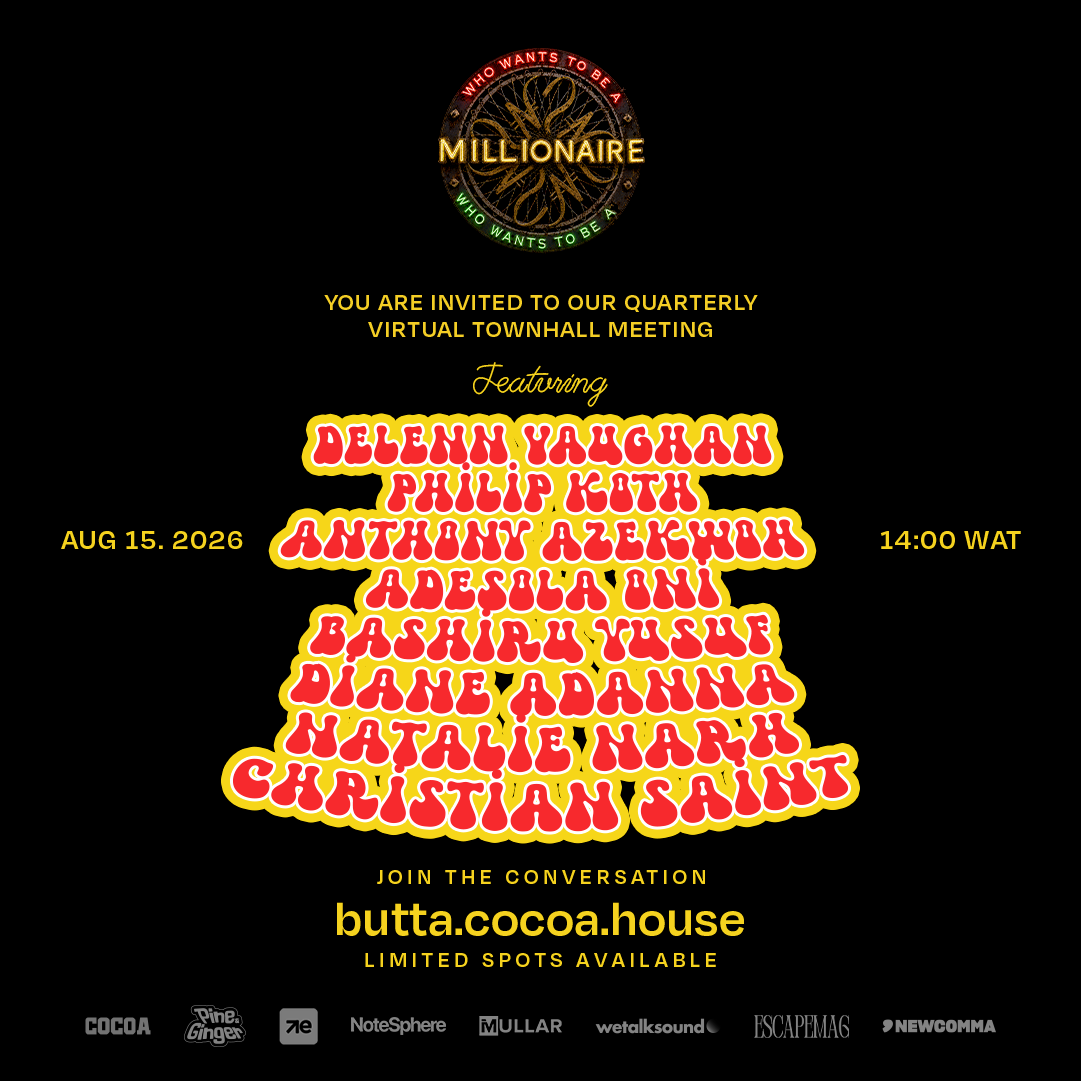
That changing reality sits at the centre of COCOA’s upcoming town hall, “Who Wants to Be a Millionaire?”, a conversation examining how inflation is reshaping the economics of creative work across Africa.
Taking place on Saturday, August 15 at 2:00 PM WAT via Zoom, the town hall will bring together creatives and industry voices including Delenn Vaughan, Philip Koth, Anthony Azekwoh, Adeshola Oni, Bashiru Yusuf and Diane Adanna, with Natalie Narh of NewComma moderating.
The premise is simple, but the problem is not: what does it actually mean to build a creative career when everything costs more?
For artists, designers, filmmakers, photographers and other creative professionals, inflation doesn’t stop at rent or groceries. It reaches the studio, the camera, the laptop, transportation, production crews, software, materials and, perhaps most importantly, the price of their own labour.
As costs rise, creatives are being forced to rethink how they price projects, negotiate fees and decide which opportunities are worth taking. A job that once made financial sense can now leave little behind once the real cost of producing it is accounted for.
Bisola Abimbola, Editorial Lead at COCOA, says the changing value of money is also changing what creatives believe is possible.>
“A few years ago, a million naira could meaningfully change what was possible for someone. Today, that same million can disappear into the cost of producing a project before the work even gets off the ground.”
That tension is what gives the town hall its title. Who Wants to Be a Millionaire? borrows the familiar language of wealth and turns it into a question about purchasing power, ambition and survival. If a million naira no longer takes you as far as it once did, how much does it take to build a sustainable creative career now?
The conversation will look beyond the headline figure to the decisions happening underneath it: how creatives set their rates, protect their value, fund their work, choose clients and navigate an economy where earning more does not necessarily mean having more.
For an emerging creative trying to turn talent into a career, these aren’t abstract economic questions. They can determine whether a project gets made, whether a freelancer accepts an underpaid opportunity, or whether someone can afford to keep creating at all.
COCOA’s town hall arrives at a moment when Africa’s creative industries continue to attract global attention, while many of the people powering that growth are still figuring out how to make the work financially sustainable.
The bigger question, then, isn’t simply who wants to be a millionaire?
It’s what does it take to stay creative when becoming one feels further away?
Ras Kimono, the legendary Rub-A-Dub master of blessed memory was honoured through the artistic legacy he innately planted; one that continues to authentically bloom through the next generation. His daughter, Oge Kimono gracefully received the baton, carrying forward his conscious message and creativity through the transformative power of music.
An accomplished creative in her right, she hosted the Ras Kimono Day (Tribute Edition) in collaboration with the Dub & Riddim Movement on the 14th of June, saluting her father’s timeless legacy eight years after his passing. The intimately curated event was memorably meaningful as it was held at a venue deeply connected to Ras Kimono’s journey; one where he performed during his lifetime, making the celebration both a tribute and return to cherished memories.
Reflecting on the venue of event, Oge Kimono tells LSTV:
“The venue was, and still is a memory because that’s where we started Dub & Riddim in 2017; a weekly reggae party hosted by me. It carried a spirit similar to what my dad used to do in the 80s at Floating Bukka in Marina, Lagos. What made it even more special was that whenever I was out of town and unable to host or anchor the party, my dad would step in whenever he was around and hold the space for me. It became more than an event; it became a continuation of legacy across generations.”
When she was going through his belongings to carefully select archival material to be showcased that day, she described the experience as incredibly emotional, making her feel nostalgic when she came across his newspaper articles from the 80s, audio cassettes, photographs, vinyl records, and treasured memorabilia. Each piece carried memories that reminded her of his legacy, journey and impact.
She narrated how one of her costumes she wore on that day was her father’s; keeping his memory alive in real time. She performed his hit songs, Under Pressure released in 1988, What’s Gwan and Jah Guide I released in 1990, amongst others. The good vibes inna di place? Highly contagious; everyone feeling irie! Bomboclaat!!
With lovers and well wishers of Ras Kimono and the Rastafari movement, everyone looked stylish in their rasta costumes; waving the flag and blowing them bomboclaat whistles. Everywhere was lit up with genuine laughter and unity and on the dance floor.
In her words, she also tells LSTV why hosting the tribute was important to her, the music industry and her family.
OGE KIMONO: Hosting the tribute was very important to me; lest we forget those who laid their backs so we could walk, run and fly. Beyond upholding his legacy, it was also an opportunity for the younger generation to know and learn about him, his music and the message he stood for.
The art of bringing people together through the unwavering magic of reggae music to honour a conscious messenger who has passed on creates an avenue to foster genuine YOUNITY. More than a tribute, it’s time travel; a moment for reflection, remembrance, and introspection. It paves a way to reconnect with divine messages of wisdom, consciousness, one love, and social awareness that inspires positive change; not those negative mainstream music slowly causing brain rot. It also ensures that his voice continues to inspire generations.
One by one, we step out of Babylon, chanting in unism.
Last night, 2x GRAMMY-nominated Afrobeats artist Asake took to the stage at London’s Theatre Royal Drury Lane for a rare and intimate performance of his critically acclaimed album M$NEY. Presented in partnership with Spotify, the invite-only event drew friends, family, and a selection of Asake’s most dedicated listeners for an evening that felt as deliberate as the music itself.
The performance marked the first time Asake had brought M$NEY to a live audience since the album’s release in May, and he did not arrive quietly. Backed by a full live orchestra, Asake moved through the project’s tracklist before unveiling four previously unheard songs, giving those in the room something no stream could replicate. The entire night was captured on film, with a full concert film set to land on Spotify in the coming days.
A record built around gratitude, prosperity, spirituality, and ambition, M$NEY distils everything that makes Asake one of the most compelling voices in contemporary Afrobeats, his melodic instincts sitting effortlessly over rhythms that feel both rooted and expansive. On release, the album topped streaming charts in over 19 countries including Nigeria, peaked at No. 8 in the United States, and saw Asake ranked the No. 15 digital artist globally by Kworb Data, placing him among the most streamed artists on the planet.
Last night was the room catching up with what the numbers have been saying for weeks.
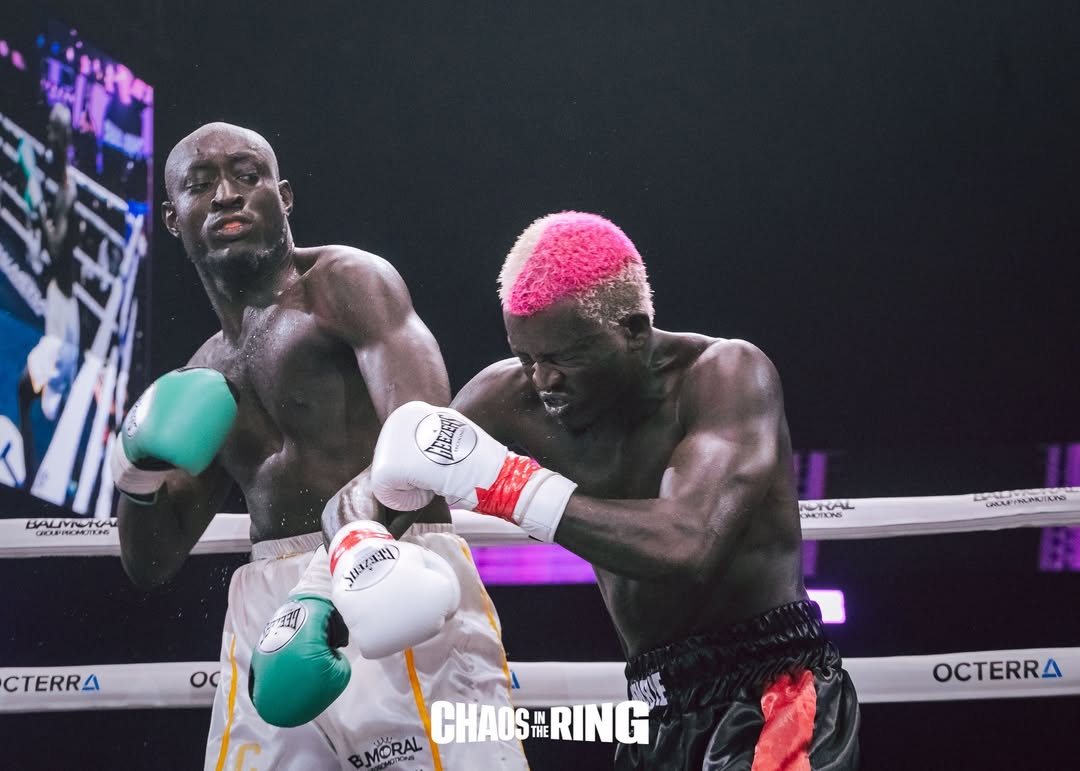
On May 1st, something unusual happened in Nigerian entertainment. Two non-professional fighters stepped into a boxing ring: Carter Efe, the fast-rising streamer whose internet growth has become impossible to ignore, and Portable, a street-pop artist who has turned unpredictability into an entire brand. In less than four rounds, the fight was over. But the real story was never the fight itself. It was everything surrounding it.
At face value, the bout looked like exactly the kind of celebrity spectacle the internet feeds on: chaos, controversy, and attention. And to be fair, it delivered all three. Portable entered with exhibition experience from previous fights against Charles Okocha and Speed Darlington. Carter Efe came in with none, yet controlled the fight from the opening moments and finished convincingly. Still, technical quality was never really the attraction here. The attraction was clout.
Almost immediately, clips from the event flooded TikTok, Twitter, Instagram, and meme pages. Reaction videos, edits, commentary threads, and recreated moments spread faster than the fight itself. For days, the internet treated the event like a national occurrence. DAZN broadcasting the bout only amplified things further, giving what could have been dismissed as local internet chaos an unusual level of global visibility.
That visibility matters because it reveals something deeper about modern Nigerian entertainment culture. Carter Efe represents a newer kind of internet celebrity; chaotic, spontaneous, and constantly evolving in public. Portable operates differently. His visibility thrives on unpredictability. Whether through music, controversy, interviews, or public incidents, he has mastered the attention economy in ways many artists still struggle to understand. Put both personalities in a ring and the outcome almost becomes secondary. The event becomes content before it even begins.
Before the celebrity main event, there were undercard fights involving lesser-known fighters, and some showed real promise. For brief moments, you could almost see the outline of something sustainable underneath all the noise. Because if personality alone can generate this level of attention, what happens when actual structure, training, and long-term investment enters the picture?
Backed by Balmoral Group in partnership with DAZN, the event was packaged, funded, and distributed seriously. Reports from stakeholders suggested budgets running into billions of naira, alongside temporary local jobs, tourism activity, and international attention directed toward Lagos. At that point, this stops feeling like entertainment alone. It starts looking like infrastructure.
That is why boxing in Nigeria suddenly feels like it could be more and more like a legitimate opportunity. The audience already exists, the attention could be upscaled. Even the commercial potential becomes difficult to ignore. What remains uncertain is whether the structure can catch up before the hype burns out.
For boxing to survive beyond spectacle, the foundation has to become intentional. Fighters need proper coaching, conditioning, and technical development capable of competing globally over time. Safety standards, medical oversight, and post-fight care cannot be optional in a sport this dangerous. Then comes compensation. If fighters cannot build stable careers locally, they will leave, repeating the same cycle seen across Nigerian football, tech, and other industries where talent develops at home but thrives elsewhere because the systems abroad simply work better.
And yet, the momentum still feels real. More events are already being planned, promoters are openly discussing expansion, and audiences are paying attention in ways they have not before. The Carter Efe and Portable fight will probably be remembered for the chaos, the memes, and the internet reactions. But its real significance might be what it quietly proved: Nigeria is not lacking in talent, audience, or global attention. What it has consistently lacked is structure. And for the first time in a while, it feels like people are finally starting to pay attention.
Last night carried a charge that never let up. From the opening beat to the final encore, Blaqbonez commanded the room with the kind of stage presence that turns a performance into a shared experience, the crowd locked into every lyric, every adlib, every moment.
He tore through tracks from No Excuses, teased what’s next on No Excuses Deluxe, and even shared some Naira in London, truly one of one. Then he took us on a journey through the hits: BBC, Bling, Fendi, ACL — records that had the room fully immersed in that unmistakable rap energy.
Through the lens of culture curator Ayo Lawa [ @fujilope] , the night comes alive in frames that don’t just capture moments, they preserve the feeling. Intimate, almost ethereal, and unapologetically Blaqforce.
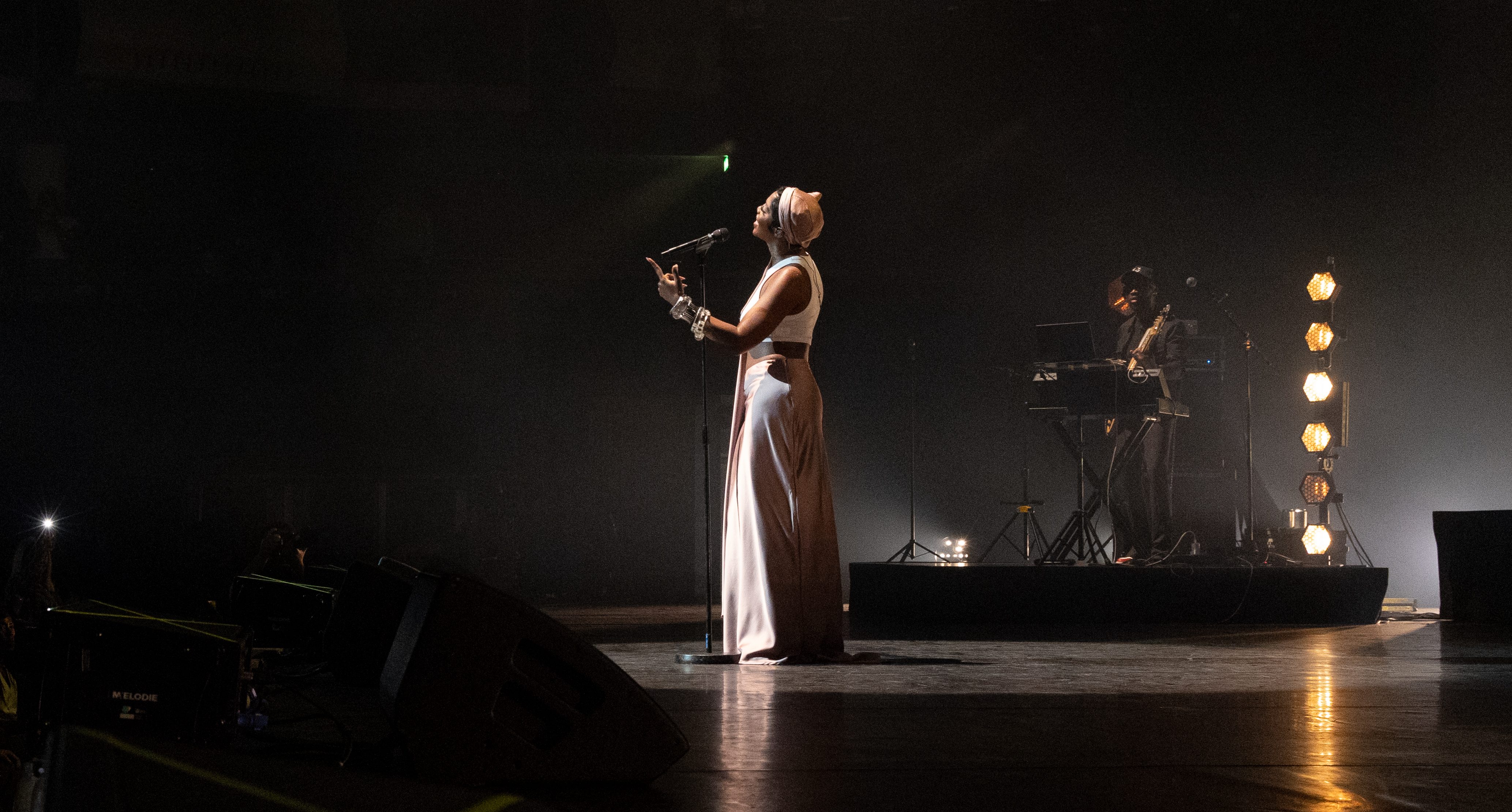
The moment I saw Tiwa Savage listed as one of the headliners for this year’s Meltdown Festival, curated by Little Simz at the iconic Southbank Centre, I knew exactly what I was in for — a time. A time down memory lane, a time of angelic vocals, pure creative energy and nostalgia wrapped in elegance.
Tiwa’s music has soundtracked so many moments for me. Once Upon A Time, my cousin and I used to drive to my internship in Lagos, blasting her debut album in an old Honda Civic like it was gospel. So, this being my first time seeing her live, the expectations were high — and she met every single one.
Let’s start with how early she hit the stage — no delays, no fuss — just a cinematic, spellbinding intro that pulled us straight into her world. She opened with “Save My Life” from her Celia album, and from there, it was hit after hit, moment after moment. Sometimes we stood in awe, other times we sat back and let the vocals wash over us.
And she’s funny too? Tiwa had us cracking up in between songs, throwing in cheeky self-praise that the crowd absolutely ate up. “Talk your sht, girl!”* someone screamed, and we all agreed. She gave love to her mum, her dad, her friends, even her English teacher in the audience — it was giving love, gratitude, and legacy.
But wait — I’m not even done. After the show, I got to meet her backstage and… let’s just say I froze. Cold feet. I said absolutely nothing that made sense. But it didn’t matter. I’d just witnessed the queen of Afrobeats in her full glory.
Can’t wait to experience her again. This one? I’ll remember for a long, long time.
On May 21st, 2025, The Afroniche Society [@theafronichesociety] returns with its second event of the year — hosted at the iconic @ustwo space in Shoreditch.
This edition is themed CURATION (in African art and culture) — a necessary and urgent conversation on what it means to curate culture in today’s world, especially through the lens of African and Black creatives.
Expect a vibrant evening featuring:
Panel discussions
Interactive debates
A hands-on curation workshop
A community mixer to build meaningful connections
This isn’t just another event — it’s a space to challenge narratives, share ideas, and imagine new cultural futures.
Don’t miss this moment of reflection, resistance and reconnection.
Ebelebe took the stage at exactly 9pm and the rest is history
EBELEBE took the stage at the iconic KOKO Camden on Friday night, backed by his band and DJ, ready to run through a vibrant selection from his discography — especially his debut album Stubborn. The Nigerian superstar brought energy, charisma, and everything we came for.
For me, it was really the dancers that stole the show. Appearing at intervals, they delivered stellar performances to lyrics that practically conjure sensuality. And Vict0ny? He didn’t waste the moment — performing in sync with their every movement like it was all one seamless groove.
When it comes to production and setlist, one standout for me was the transitions between songs. One thing I’ve noticed in the Afrobeats live scene is how rough those transitions can be. But not here. Vict0ny embodied his creative edge with transitions that felt intentional and smooth, keeping the energy flowing without a single dip.
By 10 PM, the set wrapped up (KOKO had another event lined up), but it didn’t feel rushed. From start to finish, the audience was locked in, riding every beat. Vict0ny was the perfect leader for his Outlaw nation — myself included.
And this chant? It’s still in my head. TONY, WE WANNA PARTY!!