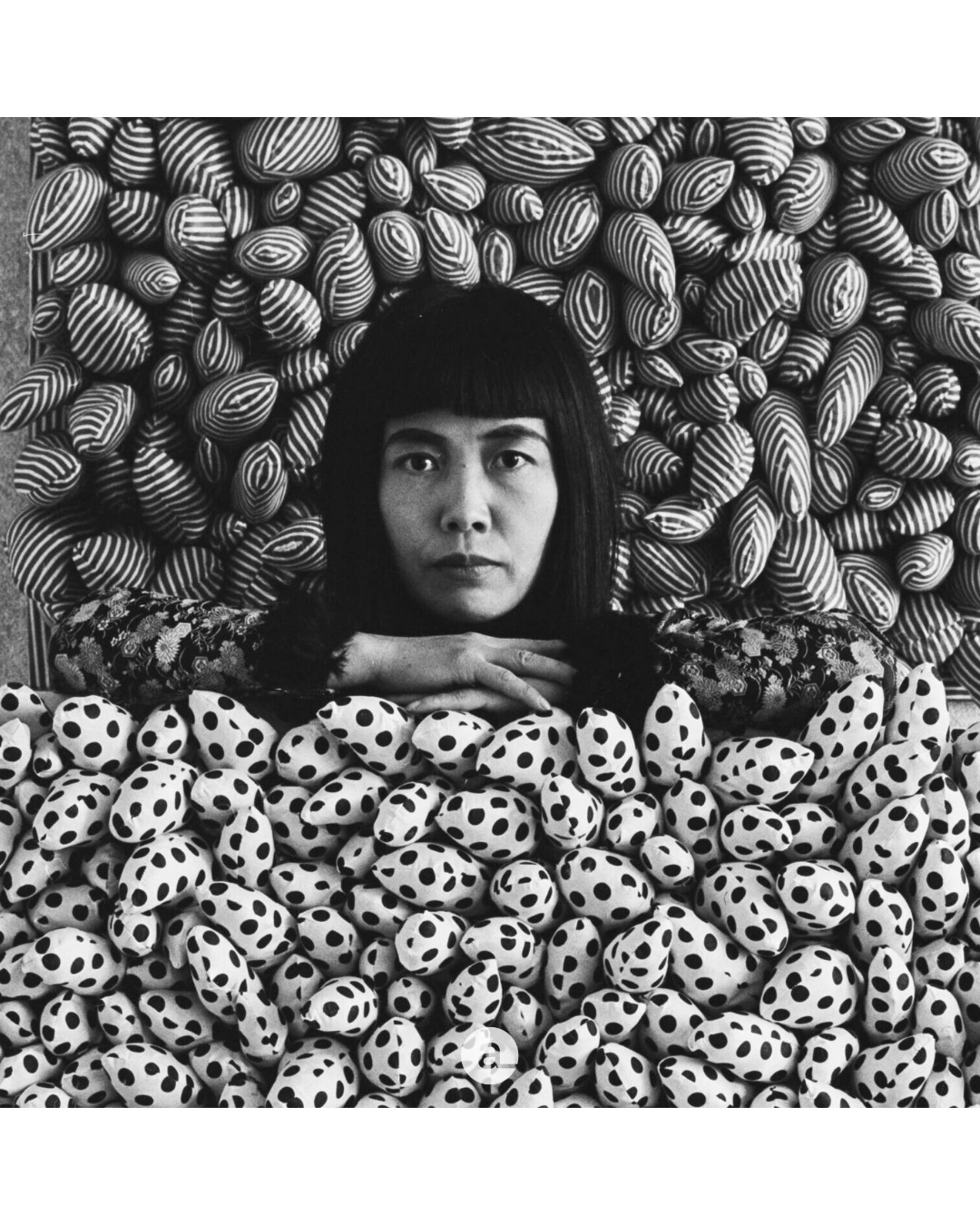
Yayoi Kusama built a visual language so distinctive that, eventually, it needed little introduction.
The polka dots, Infinity Nets, pumpkins, mirrors and obsessive repetition became recurring signatures of a practice that stretched across painting, sculpture, performance, film, writing and immersive installation.
Born in Matsumoto, Japan, in 1929, Kusama moved to New York in 1957 and quickly became part of the city’s avant-garde art scene. There, she produced the large-scale Infinity Nets, soft sculptures and experimental happenings that challenged the boundaries of what art could be.
Over the decades, repetition became more than a recurring aesthetic in her work. It became a way of exploring infinity, self-obliteration, space and perception.Her Infinity Mirror Rooms, in particular, transformed those ideas into environments audiences could physically enter, helping establish Kusama as one of the most recognisable figures in contemporary art.
Her influence, however, was never confined to museums and galleries.
Kusama’s visual language proved remarkably adaptable, finding new audiences through fashion, design, beauty, automobiles, food and popular culture.
Her collaborations with Issey Miyake, Coca-Cola, BMW MINI, UNIQLO, iida, Lancôme, X-girl, XLARGE, Veuve Clicquot, HEYTEA and Louis Vuitton translated her signature motifs into clothing, mobile phones, beauty products, cars, bottles, packaging, storefronts and immersive experiences.
Her collaborations with Louis Vuitton in 2012 and again in 2023 brought the dots, pumpkins and mirrored imagery into fashion and retail on a global scale, while later projects such as her work with HEYTEA showed how naturally her visual vocabulary could move into everyday consumer culture.
That ability to cross boundaries is central to understanding Kusama’s enduring influence.
The language she developed over decades could move from a canvas to a mirrored room, from a sculpture to a handbag, and from a gallery into the street without losing its unmistakable identity.
Few artists have created a visual language with that kind of cultural reach, and fewer still have made repetition feel endlessly new.
Curated by Dara Shonubi, the two-day exhibition brings together Phillip Udeka, Johaan Martins, Z4, Ayomide Popoola, Daevees, Nathaniel Goodnews and Laila Shuaib around ideas of uncertainty, experimentation and renewal.
In a creative landscape where uncertainty can easily become part of the job description, “We Go Again” makes a simple but weighty proposition: keep making.
The group exhibition, curated by Dara Shonubi in collaboration with MSVmag, brings seven emerging artists together at DIDI Museum in Lagos on August 29 and 30. Phillip Udeka, Johaan Martins, Z4, Ayomide Popoola, Daevees, Nathaniel Goodnews and Laila Shuaib will share work around persistence, play, experimentation and renewal, reflecting the realities of young artists trying to build meaningful practices while navigating an often unpredictable creative environment.
But “We Go Again” is not framed as a celebration of persistence in the abstract. Its title carries the exhaustion that can sit behind the decision to continue. For young artists, ambition exists alongside uncertainty: changing opportunities, limited resources, questions about visibility and the pressure to keep creating even when the conditions around the work are constantly shifting. The exhibition takes that reality and turns it into its central question: what does it mean to begin again, even when you are not entirely sure what comes next?
That question also gives the exhibition room to embrace different forms of artistic expression. Rather than asking the seven artists to arrive at one unified aesthetic, “We Go Again” brings their individual practices into conversation. The result is intended less as a fixed statement about where emerging Nigerian art is and more as a snapshot of artists experimenting with where it could go next.
There is an important distinction here. Going again does not necessarily mean returning to the same place. The exhibition’s emphasis on play, experimentation and renewal suggests movement rather than repetition. Persistence can mean changing direction, trying something that might fail, rethinking an existing practice or finding another way into an idea that did not work the first time.
The collaboration with MSVmag extends that idea beyond the physical exhibition. Alongside presenting the artists, the publication will document the people, ideas and stories behind the show, creating a record of this particular creative moment. In that sense, “We Go Again” becomes both an exhibition and an attempt to preserve the conversations surrounding a generation of artists figuring things out in real time.
For an exhibition lasting only two days, that archival instinct gives the project a longer life. The works may occupy the museum for a weekend, but the stories around their making, the uncertainty behind them and the decision to continue despite it all become part of a wider record of Lagos’ emerging art community.
Ultimately, “We Go Again” is less interested in presenting persistence as a polished success story than in acknowledging what it takes to keep showing up. It is a room full of artists at different points in their practices, brought together by a shared willingness to experiment, reflect and try again.
Despite the fatigue. Despite the uncertainty. Despite whatever changed between the first attempt and the next one.
We go again.
WE GO AGAIN
Curated by Dara Shonubi in collaboration with MSVmag
📍 DIDI Museum, 175A Adetokunbo Ademola Street, Victoria Island, Lagos
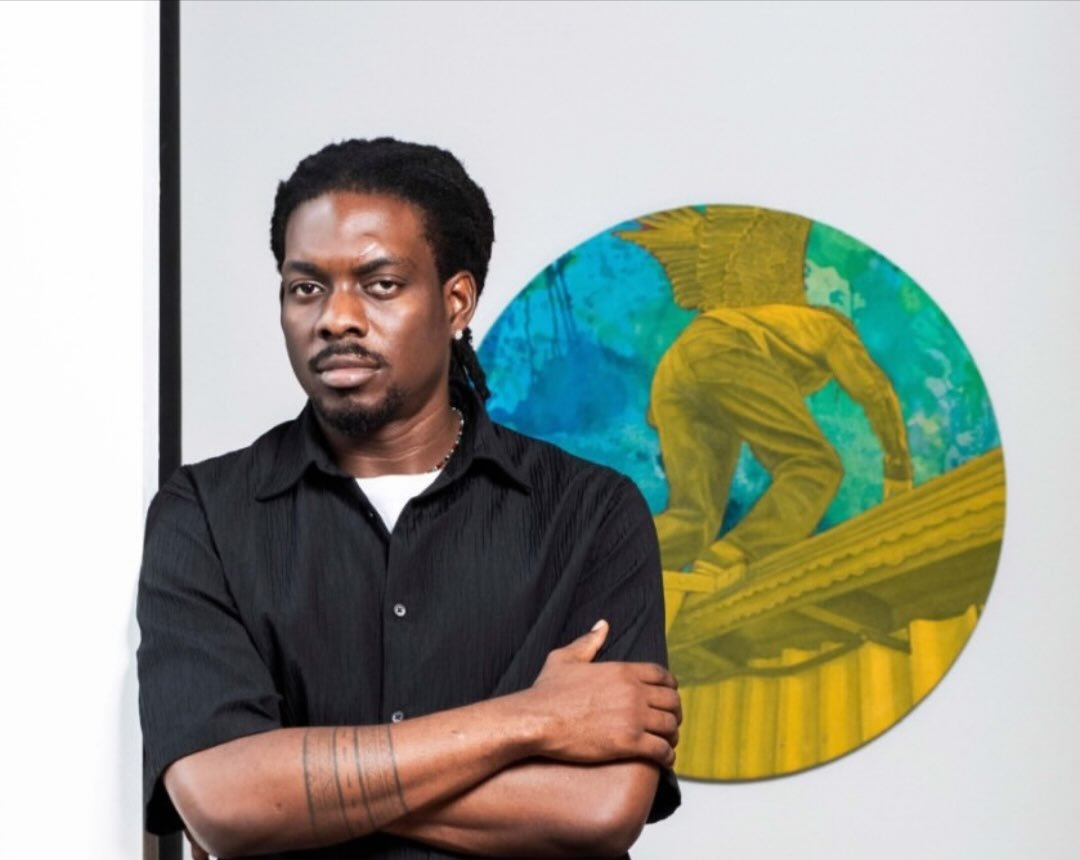
There is a moment in almost every Ken Nwadiogbu work when the illusion gives way. A figure begins to dissolve, a body breaks apart, colour takes over the canvas, and somewhere within it all, an eye looks back at you. Rendered with almost photographic precision, it has become one of the most recognisable elements of Nwadiogbu’s practice. But the eye is more than a signature. It is the thread connecting a body of work concerned with visibility, identity, memory and what it means to really look at another person.
The story behind it is deeply personal. As a child in Lagos, Nwadiogbu injured his eye while playing with his brother, tearing it on a door handle and undergoing stitches while still awake.
The experience stayed with him. So did his mother’s words that the eye is a gateway to the world. Years later, that childhood injury would become one of the defining ideas in his art, turning something that once made him self-conscious into a way of looking more closely at the world around him.
Nwadiogbu did not begin with plans to become an artist. Born in Lagos in 1994, he studied civil and environmental engineering at the University of Lagos while developing his art independently. His early charcoal drawings gained attention for their hyperrealism, often appearing so photographic that the distinction between drawing and photograph became almost irrelevant. But Nwadiogbu was never interested in realism simply as a technical feat.
He wanted the image to carry something beyond what could immediately be seen.
That thinking eventually became Contemporealism, his approach to combining hyperrealism with contemporary social and cultural ideas. His figures are often fragmented, obscured or interrupted, creating space for conversations around migration, displacement, Black identity, African culture and visibility. The realism draws you in, but the disruption asks you to stay longer. His recurring eye becomes the point of connection, confronting the viewer while giving his subjects a sense of presence that refuses to be overlooked.
His practice has continued to expand with him. Since his solo debut, A Different Perspective, in 2022, Nwadiogbu has taken his work from Lagos and Abuja into galleries and cultural spaces in London, Berlin and the United States.
His work has appeared at places including Somerset House and Saatchi Gallery, while collaborations and commissions have pushed his visual language beyond the conventional gallery setting.
He has also explored materials such as Akwete cloth, bringing his contemporary figures into conversation with histories and traditions embedded in Nigerian craft.There has been an equally visible shift in the work itself. After moving to London to study painting at the Royal College of Art, Nwadiogbu began moving beyond the monochromatic restraint of his early charcoal work. Rich reds, oranges and yellows now sit alongside his familiar figures, creating paintings that feel more atmospheric and emotionally charged. The change has not abandoned the questions at the heart of his practice. If anything, the colour has given those questions another language.
The recognition has followed. In 2025, Nwadiogbu received the Royal Society of British Artists’ Rising Star Award, before winning the Young Generation Art Award in Berlin in 2026 from a field of almost 400 applicants. Yet his trajectory remains tied to the creative community he came from. Through initiatives including Artists Connect NG and Title Deed, he continues to create spaces for emerging artists in Nigeria. For an artist whose work is so concerned with being seen, perhaps that is the most fitting extension of his practice: looking back, and making sure others have a chance to be seen too.
Collin Sekajugo’s Stock Image 017 – I Own Everything, 2019–22.
Something interesting happened in Venice in 2022. Uganda arrived at the Biennale for the first time, with a pavilion called Radiance: They Dream in Time (A Biennale is an international art exhibition held every two years, with Venice being the most prestigious one globally), and walked away with a Special Mention from the jury for best national participation. The art world clapped, wrote a few things, then turned its head to whatever came next. The artists went back to Kampala and kept working. That second part is the more important story.
Ugandan art is not a discovery. Framing it that way comes across as lazy and a bit insulting. What is actually happening in Kampala right now is a generation of artists doing genuinely original work, who built their own infrastructure when nobody built it for them, and who are getting their work into serious international rooms without apologising for where they come from.
The Artists
Acaye Kerunen
Acaye Kerunenis the clearest proof of this. She was in that Venice pavilion, and since then she has been signed by Pace Gallery, one of the most renowned galleries in the world. In January 2025, she had her first solo show in the UK, at Pace London, titled Neena, aan uthii. In Alur, her language, it means “See Me, I Am Here.” The title is not poetic decoration. It is a position statement. The show brought together textile sculptures, sound installations, and live performance, all built from materials she sources in Uganda: raffia, banana fibre, palm leaves, dried banana rind, sisal, sorghum stems. She makes these works in collaboration with communities of women across Uganda, many of whom depend on the same ecosystems that provide the materials.
Neena, aan uthii. In Alur; Images from Pace Gallery
What Kerunen is doing takes a second to fully land. Weaving and textile work in Uganda, and across much of East Africa, was historically classified under colonialism as women’s domestic craft, meaning it was invisible as art by definition. Kerunen picked that up and walked it into the most expensive gallery real estate in London.
The banana fiber is not atmospheric. It is the argument itself. Her entire practice is about dismantling the colonial and patriarchal logic that told women in this region that what their hands made was functional, not creative. She is not making that point abstractly. She is making it with her hands, in the actual material, in front of the actual institutions.
Woman with two lovers,2020 by Ian Mwesiga
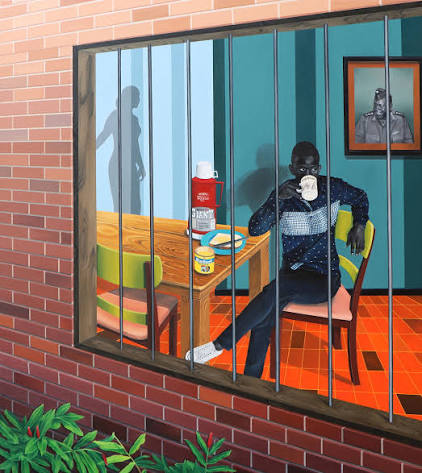
Ian Mwesiga is doing something different with oil paint on linen. He paints figures, usually alone, caught inside environments that feel nearly right but keep going slightly wrong. A man standing thigh-deep in water. A forest interrupted by a “Dead End” sign. Autumn leaves scattered across a landscape that has no business having autumn. The figures in his work occupy worlds whose rules keep shifting, where something beautiful is always one degree away from becoming threatening. He has described his process as catching sensations that pass through the mind before they can be pinned down, ideas that appear while walking or sitting, things felt but not quite seen. That sounds abstract until you stand in front of the paintings, and then it sounds exactly right.
Ian Mwesiga, Tales of the moonlight girl (2023). Courtesy: Courtesy of the artist and Mariane Ibrahim Gallery.Breakfast, 2019
His interest in painting Black identity this way began with a specific moment. In 2015, he visited the Uganda Museum and came across colonial photographs of Black people, staged in undignified postures for a foreign audience. The uncanniness in his paintings, that quality of being in a world not built for you, has a direct line back to that afternoon. He has shown at the FLAG Art Foundation in New York and works with Mariane Ibrahim Gallery. He is building a major international career without leaving Kampala.
Odur Ronald
Odur Ronald grew up in Katwe, one of Kampala’s low-income neighbourhoods, collecting and reselling metallic scraps. When he decided to make art, paint and canvas were not options he could afford. He found a YouTube video of someone embossing a soda can. He started doing the same with aluminium sheets. That practical constraint became his entire visual language. His sculptural installations are made from hammered aluminium pieces stitched together with copper wire, forming silver objects: televisions, chairs, slippers, passports dangling from ceilings.
Waagawulidde (2024)
His 2024 installation Waagawulidde, which means “Have You Heard It?” in Luganda, reconstructed the atmosphere of Uganda’s 2020 election violence using aluminium screens projecting “No Signal” and “No Vision,” embossed bullets scattered on a woven mat, overturned chairs, and a brass band playing the national anthem live. The anthem was intentional. That contrast between national grandeur and evidence of state violence is what the whole piece is doing. His work is in the Liverpool Biennial. He got there from Katwe, with aluminium.
Xenson (Samson Ssenkaaba)
Xenson, whose full name is Samson Ssenkaaba, operates across sculpture, installation, painting, performance, poetry, and fashion simultaneously and makes it look like a coherent position rather than restlessness. His work is rooted in a deep suspicion of colonialism and what it did to African self-perception, and he has spent over two decades pulling at that thread through whatever material his environment offers. In his 2024 exhibition Olidde Mupipa, held at the Nairobi Contemporary Art Institute, his first institutional solo outside Uganda, he built sculptures and installations from repurposed steel barrels, objects that begin their lives storing oil and wine for wealthier economies before being broken down and repurposed in poorer neighbourhoods as dustbins and charcoal stoves. That journey of the object, from valuable container to discarded utility, is the argument.
Olidde MupipaOlidde MupipaOlidde Mupipa
The exhibition was also his first solo at an East African institution outside his own country, which says something about how slowly the region’s art infrastructure has historically moved. He was also among the artists in Uganda’s 2024 Venice Biennale pavilion. Xenson has further built his own art space in Kamwokya, Kampala, specifically to nurture younger artists coming behind him. That act of institution-building, of not waiting for someone else to create the room, is as much a part of his practice as the work itself.
Sanaa Gateja
Sanaa Gateja has been doing something so quietly rigorous that the art world took a long time to fully reckon with what it was looking at. Known in Uganda and increasingly beyond as the Bead King, Gateja creates large-scale abstract works from rolled recycled paper beads, assembled into compositions that hold modernist grid logic and traditional Ugandan craft traditions inside the same frame without one collapsing into the other.
Blossoming, 2021 (Paper beads on hand-woven raffia)
The work is visually immediate, dense with colour and surface, but the deeper you look the more the structural thinking reveals itself. He was among the artists in Uganda’s 2024 Venice Biennale pavilion curated by Kerunen, Wan Acel | Tuli Bamu | Turibamwe | We Are One, a thirty-one artist exhibition examining collective memory and materiality across intergenerational Ugandan practice. Gateja has also invested significantly in community development through his craft, training artisans and building economic structures around his practice. The work and the community are the same project.
Voices of Peace” (2023), paper beads on barkcloth
My Conviction
What ties these five artists together is not style or medium or even generation. It is a quality of conviction. Each of them is making work that answers to an internal logic, not to what the international market has decided African art should look like or say. Kerunen’s woven declarations, Mwesiga’s disquieting figures, Odur’s silver reconstructions of political grief, Xenson’s postcolonial object theatre, Gateja’s quietly monumental bead compositions- none of these is translations made for a foreign audience. They are original statements made from a specific place, at a specific moment, by people who know exactly what they are doing.
Sanaa GatejaXenson Odur RonaldAcaye KerunenIan Mwesiga
That is ultimately what makes this generation of Ugandan artists worth sustained attention rather than a passing glance. The most interesting art being made anywhere tends to come from people who are not particularly anxious about whether the world is watching. It comes from people who are too busy working to perform availability. Kampala has always had those people. The difference now is that the rooms they are entering are large enough for the rest of the world to see them clearly, and the work, it turns out, has always been ready for that moment.
A Drum, a Crown, and the Consequences of Bad Leadership.
As a child I grew up in a house like most kids my age watching the weekly episodes of This Life, Fuji House of Commotion, Papa Ajasco, Super Story and the rest of them. But the adults around me were movie lovers and a classic now and then was normal in our house. Sunday rice for me and pounded yam for them, all of us gathered around the same television.
Although I was too young to comprehend the plots of those films at the time fully, one image became deeply ingrained in my head: a military man trying to force a crown onto his head and dying in the process. That image stayed with me for so long that the first time I heard the Abacha story, before I even knew what Abacha looked like, my brain associated the actor who played that role with him. I genuinely thought that man was Abacha.
Then there was this song by one of the characters that went like this
“Yó ma lè yín, yó ma lè yín, oro yì yó ma lè yín…”
This situation will lead to negative consequences.
From the movie, my uncle would sing it for my siblings and me anytime we were playing too rough, using style to let us know that if we did not stop playing, one of us would cry or all of us would cry. The movie became a part of my life without me knowing the plot until I got to university and decided to rewatch it, and my God, dare I say it is one of the best classics to come out of Nigeria.
Ladies and gentlemen, boys and girls of the Federal Republic, the movie I am talking about is none other than Saworoide by Tunde Kelani
The 1999 film follows the story of the fictional Yoruba kingdom of Jogbo. The movie starts with a parable of a drum played on a saworoide, a large talking drum with brass bells around it. Tunde Kelani tells us with text that it is the story of a pact between an ancient community and the kings that rule over it. Think of it like a modern-day treaty. He shows us how the treaty was done and how the special talking drum was built.
The point of the treaty was to make sure that whoever is king answers to the people. So when someone wears the crown, and they beat the drum called saworoide, and the people are not happy about him being king, the person dies. The pact forces every incoming king to submit to a ritual linking his body, conscience and reign to the drum.
In one of the first scenes, a chief goes to meet an old wise man to ask if his friend could be king, and the wise man says I already told you he who loves a good life must not aspire to be king, the king serves the people, not the other way around, and their king cannot be rich like other kings. The chief tells the old wise man that he wants his friend to become king so they can spend money, and the wise man says he could become king, but he should make sure he refuses the incisions and taking the oath because this is what connects the kings to the drum and the crown.
Lapite becomes king, refusing the coronation pact, choosing power without accountability, without thinking of the consequences. Yes, there were consequences. Any king who avoids the incisions risks sharing his crown with someone. Second, if you wear the crown and they beat saworoide he will die of a splitting headache.
Lapite’s solution was to kill the Ayàn family, the drummers and his political opponents and steal what he thought was saworoide so none of them would ever play the drum.
Not long after King Lapite took over the throne, the citizens became very unhappy. King Lapite and his chiefs did not care about Jogbo; they cared about making money for themselves. Tunde Kelani shows us this by King Lapite and the chiefs buying the latest cars with money he got from foreigners who were taking resources from the land of Jogbo, and the press asking them where they got the money. There was hunger in the land and protests by the youth.
Lapite ruled for almost twenty years, and for the citizens, it was hell. The youth took matters into their own hands, and when Lapite could no longer control the situation, he sought help from foreigners who were exploiting the land for its resources, and they supplied him with heavy ammunition and military support.
The military colonel they brought, named Lagata, saw how much money the king and the chiefs were making and decided to form a coup against King Lapite. He killed King Lapite, made himself king and ruled like a totalitarian seeking total intrusive control over every aspect of public and private life. Tunde Kelani shows us this with silent scenes of military men arresting the press, various stop and search and soldiers collecting taxes from hawkers.
To cut a long story short, the youth were able to find the surviving member of the Ayàn family to beat the saworoide on the day of Colonel Lagata’s coronation, causing him to die of a splitting headache, and the people getting their land back from corrupt leaders.
The movie ends with the wise old man telling the audience that the young and the old should all unite in building a better society.
THE CAST.
The movie is a little over twenty six years old, so the cast includes OG Nigerian actors and actresses. Some of them, like Kunle Afolayan, who plays Aresejabata, Khabirat Kafidipe, who plays Araparegangan, and the beautiful Bukky Wright, were probably at the beginning of their careers when the movie dropped. Watching them now feels like watching history in motion, seeing stars before they became the names we know today.
The older OG stars are just as powerful. Kunle Bamtefa, who many of us know as Chief from Fuji House of Commotion, plays Ogagun Lagata with chilling authority. The film is filled with a long list of Nollywood actors whose faces shaped Nigerian television and cinema for decades, giving the story a grounded, familiar weight.
The cinematography was nothing fancy, and that is understandable. This was the cassette era. But the story more than made up for it. It was not just a story. Tunde Kelani implored us, as citizens of the world, to participate in the rule of law in whatever way we can, so power does not remain in the hands of a limited few. His filmmaking is deliberate and patient. He trusts the audience to think, to listen, and to remember.
The story was relevant back in 1999 and is even more important now. I have only seen a handful of Tunde Kelani’s films, but every time, his stories make me sit still and think. That is exactly what Saworoide did to me.
The political references do not just point to Nigeria. They remind me of many countries around the world that pretend to practice democracy while power quietly shifts into the hands of a few. And that is what makes Saworoide timeless. It does not age. It waits.
POLITICAL REFERENCES.
There is an adage from the movie that I cannot stop thinking about, one that reminds me deeply of Africa. The wise man says it to one of the chiefs when the foreigners arrive with a so-called solution to help the king deal with the uprising of the youths. It was said in Yoruba. My Yoruba writing skills are not great, but you know what was great? The subtitles of this movie.
The adage goes something like this: a burglar offers to fix your doors and you are not vigilant. That line alone carries the entire weight of Africa’s relationship with the West.
It immediately reminds me of how Western countries often come in the name of “help.” Aid. Support. Development. What we now understand as saviour complex. They build infrastructure that later becomes a form of neo-colonialism. Loans that never truly end. Systems designed to keep countries dependent rather than independent.
Instead of King Lapite being diplomatic with the youths, instead of listening or addressing their grievances, what does he do? He arrests them. He kills them.
Does this sound familiar?
Yes, it does. Because End SARS read like a page torn straight out of King Lapite’s rulebook.
Another political significance that stood out to me was how the foreigners began playing both sides. At some point, they were sponsoring the youths by supplying them with ammunition, while also sponsoring the king and the police. Chaos became profitable. Instability became a business model. The longer the crisis lasted, the more leverage they had.
There is a scene where the foreigners are having a private meeting, and one of them says it is because Lapite is stupid that they are making so much money. He says they never make money this easily in other nations. Another one goes even further and says something chilling: it pays them more to have a corrupt ruler on the throne than a just ruler.
That line alone explains decades of African leadership failure backed quietly by foreign interests.
Another detail Tunde Kelani adds, subtly but deliberately, is that the king and the chiefs always keep their money in offshore accounts so as not to arouse suspicion. They steal from their own people, but they trust foreign banks more than their own land. That too feels painfully familiar. Nigeria is rich, yet the wealth of the nation sleeps abroad while its people struggle at home.
One scene I will never forget, because it reminds me so heavily of Nigeria, is when the colonel (Ogagun Lagata) brought in by the foreigners to help the corrupt King Lapite asks one of his soldiers, who is a citizen of Jogbo, what he thinks of the land. The soldier responds by saying they are suffering in the midst of plenty. He says it more powerfully in Yoruba, in a way I wish I could translate directly, but the part I understood clearly translates to: we have mats, but we sleep on the floor.
It reminds me of how many resources Nigeria has, oil, gas, land, people, creativity, intelligence, yet the majority of citizens suffer daily because of bad leadership and poor management. We have the mats. We simply are not allowed to sleep on them.
What makes Saworoide so unsettling is that it does not feel like history. It feels like now. The suppression of youths. The criminalisation of protest. Foreign interests protecting corrupt leadership. The military stepping in under the guise of restoring order. The media being silenced. The people paying the price.
Tunde Kelani is not just telling a story. He was issuing a warning. He was showing us what happens when citizens disengage, when culture is abandoned, and when accountability is traded for convenience. Jogbo could be Nigeria. It could be Sudan. It could be Congo. It could be Haiti. It could be anywhere pretending to practice democracy while power quietly concentrates in the hands of a few.
We may not have a saworoide drum today, but we have rights. And like the drum, those rights only work when the people are willing to use them.
That, to me, is why Saworoide still hurts.
And why it still matters.
I say all this to say that political participation is not for a select few. And I know it is very discouraging when you keep trying and you do not get heard. Whether it is picking a party you believe will represent your political ideology, joining conversations, holding leaders accountable, or simply going out to vote, it can feel pointless, especially when the system seems designed to ignore you.
But the truth is this: nobody is coming to save us.
That is the lesson Saworoide keeps repeating. Waiting for a perfect leader, a benevolent foreign power, or a miracle solution only leaves room for people like Lapite and Lagata to rise. Power does not disappear when citizens step back. It only moves into fewer and more dangerous hands.
Political participation does not always look grand. Sometimes it looks like asking questions. Sometimes it looks like refusing to be silent. Sometimes it looks like remembering history so it does not repeat itself. In Jogbo, the people lost their voice because they stopped guarding the pact. In real life, societies collapse when citizens are convinced that their voices do not matter.
We may not have a saworoide drum to call leaders to order, but we have laws, rights, protests, votes, conversations, and collective memory. These things only work if we use them. Democracy is not a gift. It is a responsibility that must be exercised again and again, even when it is exhausting.
So let us put the matter in our own hands. Not violently. Not carelessly. But consciously. Because the cost of disengagement is always higher than the cost of participation. And if Saworoide teaches us anything, it is that when people finally wake up, it is often after too much damage has already been done.
The choice is always the same: participate, or be ruled.
P.S. This message is not directed at Nigerians alone. If you live in a country that does not reflect your political ideology, do something about it. Silence only sustains systems that do not serve the people.
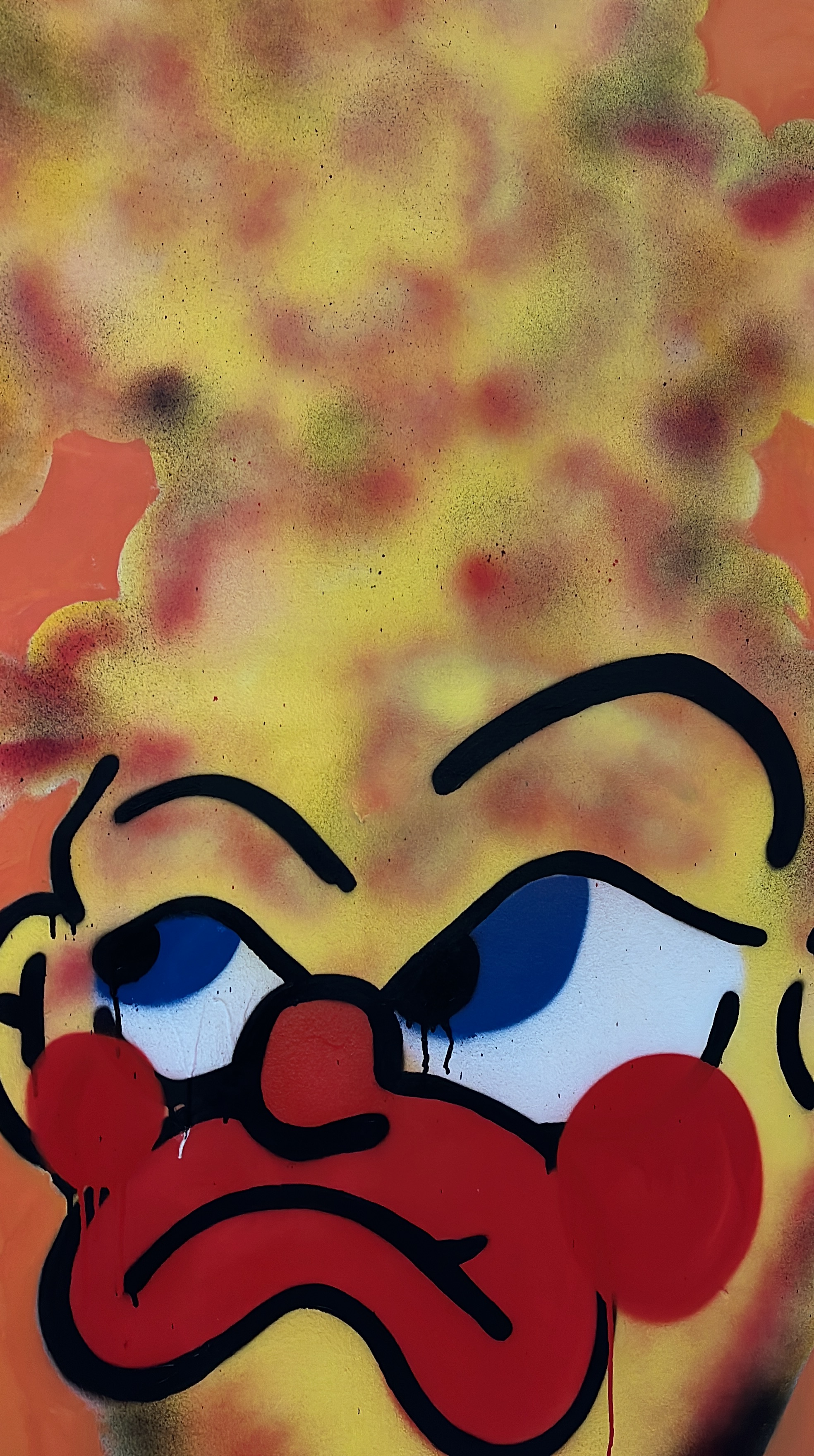
Let’s talk about Slawn—Olaolu Slawn, the London-based Nigerian artist who’s flipping the art world upside down and making it look easy. Yesterday, the man had his biggest show yet at Saatchi Yates, and to say it was a monumental moment feels like an understatement. It was more than just an exhibition; it was a cultural event. People flocked to the gallery, rubbing shoulders with creatives, collectors, and casual onlookers alike, all eager to witness history in the making.
On his X bio, he claims “my paintings are shit,” and on Instagram, he writes, “I’m not an artist, I paint like a 6-year-old.” And honestly? That’s a damn lie.
But let’s cut to the chase: Slawn is a liar. Bold statement, right? But don’t take it from me, he says it himself. On his X bio, he claims “my paintings are shit,” and on Instagram, he writes, “I’m not an artist, I paint like a 6-year-old.” And honestly? That’s a damn lie. A big one. In fact, it’s the most outrageous lie ever told in the art world. Slawn, you’re lying to us—and you’re doing it with a sly grin on your face because deep down, you know the truth: you’re a genius.
You see, Slawn’s art isn’t the work of someone stumbling through the creative process. His canvases aren’t just random splashes of color thrown together for shock value. No, his art is a calculated storm—a blend of chaos and precision that takes true mastery to pull off. Every brushstroke feels like it’s fighting for space on the canvas, yet somehow it all works together. His use of form, shape, and texture invites you into a world where disorder is actually the language of order. His pieces are layered with meaning, and you feel it as soon as you stand in front of them.
Take, for instance, his self-proclaimed Nigerian Aunty series—a collection that commands attention with bold strokes and larger-than-life figures. It demands a canvas as massive as its cultural relevance. Then there’s the audacity of his “1000 Canvas” piece—where he lets small canvases converge to form something colossal, like individual brushstrokes creating an entire universe. This is intentional art; this is the kind of creative engineering that doesn’t come from a so-called “6-year-old.”
And let’s talk about his technique for a second. Slawn’s work may appear erratic, almost whimsical at first glance, but every detail has purpose. He’s obsessed with perfection. Faces emerge from what seems like randomness, objects are reimagined and distorted in ways that challenge our perception of reality. Even his choice of canvas sizes isn’t arbitrary—it’s about creating visual dynamics that make you stop, look closer, and think harder. You’re not just viewing art; you’re entering a dialogue with it.
But what makes Slawn even more fascinating is his role as an icon for the next generation. At his exhibition, you could spot kids in the crowd, eyes wide and filled with dreams, looking at him like a living legend. It’s not just about the art he’s creating—it’s about the movement he’s inspiring. These young, hungry minds see themselves in Slawn, a Nigerian-born artist making it big in the world’s most elite galleries. You can practically feel the birth of a new creative movement brewing, one where Slawn stands as the blueprint.
And yet, despite all of this—despite the genius, despite the iconic work, despite the inspiration he’s sparking—Slawn still finds time to be a family man. Behind all the paint and the madness is a husband and father, a man who somehow balances creating mind-bending art with raising a family. This isn’t just some dude tossing paint on a canvas for Instagram likes; this is a fully-rounded human being who embodies what it means to thrive in both personal and professional realms. And if that weren’t enough, Slawn is a sharp businessman too. His art may speak in abstract, but his business game? Crystal clear.
” I would like to say at this point i was only admiring the art and it’s okay to admit this was my fave piece cos i kept coming back to it. ”
So, here’s my message to Slawn: keep lying. Keep telling us you’re not an artist, that your paintings are “shit,” because each lie is a masterstroke. With every self-deprecating comment, you’re quietly rewriting the rules of what it means to be a creator in today’s world. You’re showing us that art doesn’t have to be about pretension—it can be about raw, unfiltered expression. You’re proving that you don’t have to fit into a neat little box to be great.
Keep lying, Slawn, because the world needs more liars like you—artists who dare to challenge conventions, inspire new generations, and redefine what’s possible. The future is bright for you, and if anyone’s still doubting that, they’re not paying attention. We’re witnessing history with every stroke of your brush. And trust me, we’re all here for it.