Written by Emmanuel Morounfolu

Something interesting happened in Venice in 2022. Uganda arrived at the Biennale for the first time, with a pavilion called Radiance: They Dream in Time (A Biennale is an international art exhibition held every two years, with Venice being the most prestigious one globally), and walked away with a Special Mention from the jury for best national participation. The art world clapped, wrote a few things, then turned its head to whatever came next. The artists went back to Kampala and kept working. That second part is the more important story.


Ugandan art is not a discovery. Framing it that way comes across as lazy and a bit insulting. What is actually happening in Kampala right now is a generation of artists doing genuinely original work, who built their own infrastructure when nobody built it for them, and who are getting their work into serious international rooms without apologising for where they come from.
The Artists

Acaye Kerunen is the clearest proof of this. She was in that Venice pavilion, and since then she has been signed by Pace Gallery, one of the most renowned galleries in the world. In January 2025, she had her first solo show in the UK, at Pace London, titled Neena, aan uthii. In Alur, her language, it means “See Me, I Am Here.” The title is not poetic decoration. It is a position statement. The show brought together textile sculptures, sound installations, and live performance, all built from materials she sources in Uganda: raffia, banana fibre, palm leaves, dried banana rind, sisal, sorghum stems. She makes these works in collaboration with communities of women across Uganda, many of whom depend on the same ecosystems that provide the materials.

What Kerunen is doing takes a second to fully land. Weaving and textile work in Uganda, and across much of East Africa, was historically classified under colonialism as women’s domestic craft, meaning it was invisible as art by definition. Kerunen picked that up and walked it into the most expensive gallery real estate in London.

The banana fiber is not atmospheric. It is the argument itself. Her entire practice is about dismantling the colonial and patriarchal logic that told women in this region that what their hands made was functional, not creative. She is not making that point abstractly. She is making it with her hands, in the actual material, in front of the actual institutions.

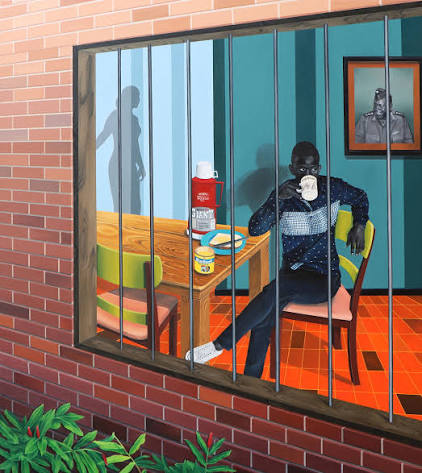
Ian Mwesiga is doing something different with oil paint on linen. He paints figures, usually alone, caught inside environments that feel nearly right but keep going slightly wrong. A man standing thigh-deep in water. A forest interrupted by a “Dead End” sign. Autumn leaves scattered across a landscape that has no business having autumn. The figures in his work occupy worlds whose rules keep shifting, where something beautiful is always one degree away from becoming threatening. He has described his process as catching sensations that pass through the mind before they can be pinned down, ideas that appear while walking or sitting, things felt but not quite seen. That sounds abstract until you stand in front of the paintings, and then it sounds exactly right.


His interest in painting Black identity this way began with a specific moment. In 2015, he visited the Uganda Museum and came across colonial photographs of Black people, staged in undignified postures for a foreign audience. The uncanniness in his paintings, that quality of being in a world not built for you, has a direct line back to that afternoon. He has shown at the FLAG Art Foundation in New York and works with Mariane Ibrahim Gallery. He is building a major international career without leaving Kampala.

Odur Ronald grew up in Katwe, one of Kampala’s low-income neighbourhoods, collecting and reselling metallic scraps. When he decided to make art, paint and canvas were not options he could afford. He found a YouTube video of someone embossing a soda can. He started doing the same with aluminium sheets. That practical constraint became his entire visual language. His sculptural installations are made from hammered aluminium pieces stitched together with copper wire, forming silver objects: televisions, chairs, slippers, passports dangling from ceilings.

His 2024 installation Waagawulidde, which means “Have You Heard It?” in Luganda, reconstructed the atmosphere of Uganda’s 2020 election violence using aluminium screens projecting “No Signal” and “No Vision,” embossed bullets scattered on a woven mat, overturned chairs, and a brass band playing the national anthem live. The anthem was intentional. That contrast between national grandeur and evidence of state violence is what the whole piece is doing. His work is in the Liverpool Biennial. He got there from Katwe, with aluminium.

Xenson, whose full name is Samson Ssenkaaba, operates across sculpture, installation, painting, performance, poetry, and fashion simultaneously and makes it look like a coherent position rather than restlessness. His work is rooted in a deep suspicion of colonialism and what it did to African self-perception, and he has spent over two decades pulling at that thread through whatever material his environment offers. In his 2024 exhibition Olidde Mupipa, held at the Nairobi Contemporary Art Institute, his first institutional solo outside Uganda, he built sculptures and installations from repurposed steel barrels, objects that begin their lives storing oil and wine for wealthier economies before being broken down and repurposed in poorer neighbourhoods as dustbins and charcoal stoves. That journey of the object, from valuable container to discarded utility, is the argument.


The exhibition was also his first solo at an East African institution outside his own country, which says something about how slowly the region’s art infrastructure has historically moved. He was also among the artists in Uganda’s 2024 Venice Biennale pavilion. Xenson has further built his own art space in Kamwokya, Kampala, specifically to nurture younger artists coming behind him. That act of institution-building, of not waiting for someone else to create the room, is as much a part of his practice as the work itself.

Sanaa Gateja has been doing something so quietly rigorous that the art world took a long time to fully reckon with what it was looking at. Known in Uganda and increasingly beyond as the Bead King, Gateja creates large-scale abstract works from rolled recycled paper beads, assembled into compositions that hold modernist grid logic and traditional Ugandan craft traditions inside the same frame without one collapsing into the other.

The work is visually immediate, dense with colour and surface, but the deeper you look the more the structural thinking reveals itself. He was among the artists in Uganda’s 2024 Venice Biennale pavilion curated by Kerunen, Wan Acel | Tuli Bamu | Turibamwe | We Are One, a thirty-one artist exhibition examining collective memory and materiality across intergenerational Ugandan practice. Gateja has also invested significantly in community development through his craft, training artisans and building economic structures around his practice. The work and the community are the same project.

My Conviction
What ties these five artists together is not style or medium or even generation. It is a quality of conviction. Each of them is making work that answers to an internal logic, not to what the international market has decided African art should look like or say. Kerunen’s woven declarations, Mwesiga’s disquieting figures, Odur’s silver reconstructions of political grief, Xenson’s postcolonial object theatre, Gateja’s quietly monumental bead compositions- none of these is translations made for a foreign audience. They are original statements made from a specific place, at a specific moment, by people who know exactly what they are doing.


That is ultimately what makes this generation of Ugandan artists worth sustained attention rather than a passing glance. The most interesting art being made anywhere tends to come from people who are not particularly anxious about whether the world is watching. It comes from people who are too busy working to perform availability. Kampala has always had those people. The difference now is that the rooms they are entering are large enough for the rest of the world to see them clearly, and the work, it turns out, has always been ready for that moment.
Leave a Reply