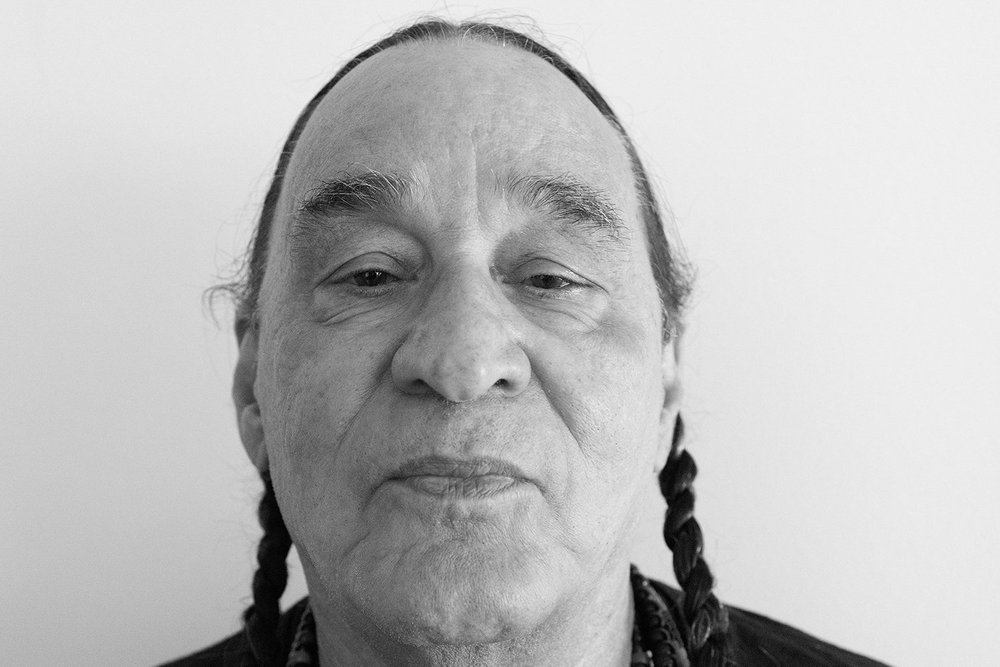
Written and Interviewed by Zionne Soule
Images By Ajani Charles/ @ajaniphoto (IG)
Before hip hop culture was validated by charts and algorithms, there was a sacred contract created in the streets of New York City with a man and his 35mm camera guided by indigenous wisdom and a devotion to cultural preservation, walking into the fire as a witness.
The great hip hop historian Ernie Paniciolli, commonly known as (Brother Ernie) didn’t just document history through visual storytelling for five decades, he protected its core; capturing a generation transmuting survival into revolutionary art. I’ve been a supporter of his works and messages for a long time; from his popular book Who Shot Ya published in 2002 documenting three decades of hip hop history through visual stories and Hip Hop at The End of The World published in 2018; documenting four plus decades of the culture with over 250 photos. He was inducted into the Hip Hop Hall of Fame in 2014 and his documentary The Other Side of Hip Hop:The Sixth Element won Best Documentary at the Big Apple Film Festival in 2007.
I am creating this piece to honour and appreciate him for his service to humanity and the culture he preserved for generations to come; so I thought it would be nice to have a distinct perspective on his journey and experiences as a sacred archivist and custodian of the culture since its inception. In his warm and welcoming aura, we had a great conversation over google meet and the session was so insightful. Thank you for the culture you have preserved for us, Brother Ernie!

Step into the conversation with a cultural historian, where every image is a weapon of cultural preservation:
Before the world knew you as Brother Ernie, who were you? What did you see in hip hop that made you feel it was a culture worth dedicating your life to documenting?
Wow! (He laughs) good question. Excellent question.
I was a father first, a working man, a simple person (I’m still a simple person) and I believe that if you’re given the opportunity to make a change in the world, then you have to take that opportunity and make it as positive as possible because they’re a lot of negative forces out there and you don’t wanna be aligned with that.
The world needs more unity, hope, a push and so many hugs. If you can do that, do it. Being a tough guy or being proud does nothing for no one.
You have to use any opportunity you have to lift people up, make them smile and be grateful for life and you’ll be surprised how much a little bit of hope and affection can change a person’s attitude and environment. That’s like medicine for me, it’s like my religion.
You’ve spoken about walking into rough neighborhoods with your camera, operating on a shield of respect because people knew you were there to preserve their memory. Looking back now, how did that unspoken agreement between you and the streets shape your definition of what it truly means to be a cultural archivist?
Most people call me a photographer, some people call me some bad things. (He laughs). Calling me a cultural archivist is a beautiful thing and that’s an absolute truth because in 20-30 years from now, it’s the photographs, the memory, the books, the writing, the poetry and the artefacts that are going to be remembered.
I’ve been on this earth for almost 80 years and throughout my lifetime, I know what I’ve seen and experienced. I’m sure you’re also a witness of how quickly time passes. A little baby you held in your hands is now driving his own car and has his own family. A child you taught how to read is now writing books.
You have to take advantage of every moment because you never know when the last moment will be. It’s our duty as artists to make the world just a little bit brighter. I don’t wanna sound like a missionary but damn; we can change everything just with a smile, a laugh, with hope and sharing.
The idea that my work is published in museums, schools and colleges around the world and I’ve never had a 5 minute photography class proves that my philosophy of humanity is a truthful and timeless one.
When you were documenting the early days in New York; from the graffiti, the block parties and the youth transmuting struggle into poetry, did you realize you were documenting a global cultural movement, or did the impulse come from an urge to make sure the hood wasn’t erased from history’s time machine?
I think a little bit of both but primarily, I felt instinctively and spiritually that what was happening was going to be historical and it was unique. It was a vibe because this was art from the streets, this was art from kids who had no training like me. I had no training in photography and painting.
Art comes from your spirit, your soul, your energy, your vibrations. So yes, I did that out of an almost primitive desire to help and hope that it lasted and that future generations will be able to see and acknowledge the culture and appreciate those who documented it.
As a photographer who captured icons like Rakim Allah, Public Enemy, Tupac and Lauryn Hill, how did you translate that musical density into visual frames without using words?
Before picking up a camera, I was a painter. I had been painting and drawing since I was a child and I discovered that painting, drawing and visuals were a way to capture memories. I was lucky and blessed to have the energy and the spirit to embrace these artists and engage with them. Rakim Allah just did a dedication of my new book and I don’t think he’s ever done a dedication for a book before and he talks about that exact thing in my new book.
How did your Cree Native American heritage inform the way you viewed community, lineage and the preservation of hip hop’s history?

I think it was instinctive. I don’t like using the word instinctive because people think we’re somehow less than intelligent but I believe that everything in me was instinctive and I think that my camera caught all the magic; that was instinctive so yes I’m going to defer and use the word instinctive.
Your work gave pioneers, Poor Righteous Teachers and young dreamers nobility. How did you maintain that standard of dignity when the outside world was trying to turn hip hop into a commercial product?
(He laughed hard) That’s the most perfect question.
The Poor Righteous Teachers did a song called Illuminati which was a copy of a video we made with the Zulu nation 20 years before and I suggest you look up the song. It’s not the typical fantasy world of illuminati, it’s the actual changes where they talk about how they have seeds that restrict the rebirth of seeds. In other words you can plant a flower or food and it isn’t going to generate seeds and create more food. You have to keep going back to the people that sell the seeds and the Poor Righteous Teachers put out so much information in that Illuminati song that it came through almost as a divine message.
With thousands of your photos permanently preserved at Cornell University, (Thank you for your service); your archive stands as a timeless historic record. In a society that attempts to rewrite and filter marginalized history, how does archiving act as a form of cultural resistance?
I don’t wanna limit myself but I believe that everything I do is a form of cultural resistance. Everything I do on a subliminal level is either spiritual or psychological warfare against a coloniser and a culture that is almost extinct at its core. Everything I do is radical because it’s a mixture of the spiritual and the revolutionary.
How did you build trust with these artists to get past their armor and capture who they were when the mic was off?
(He laughs euphorically) I love your questions.
That’s the whole secret of being a master photographer, a master painter, a master as you’re an interviewer. It’s getting their confidence and aligning with their comfort level; making the person or people you’re interviewing, interfacing or capturing understand that this isn’t a conventional gathering; they’re not asking you anything about commerciality or the money, they’re just coming at you with a physical, spiritual and creative idea; transmuting it into a better way.

I say this as humbly as I possibly can; I try to make my camera a weapon like John Coltrane made his saxophone a weapon; blessing it with power that creates unity, openness, psychological spiritual excellence and oneness with humanity as a revolution because it casts away all the low vibrational energies in our culture; like getting people to dance to the same regular beat and disseminating demoralizing information through sound; but true culture is spiritual, it’s a rhythm, it’s a high vibrational frequency.
What has carrying 5 decades of visual memory cost you, and what kept you grounded through the heaviest eras of the culture?
Wow! Again I have to give you credit, your questions are on an interior level.
I’ve just tried to stay true to my inner voice, to my culture and to my ancestors and I try to put that into the work I do and every photograph I take. Every time I do any public speaking, I try to activate and stimulate all connections to our ancestors, to our people and to our vibrations. I try without trying to be a holy man or a philosopher. I just try to do it and it ricochets my spirit, into my voice and into my ideas so many times. If you listen to what I’m saying, just close your eyes and see if you can follow where that path leads.
If a young photographer, painter or writer came to you today wanting to document their local scene; from their subculture, their street corner and their sound, what ethical code must they hold on to if they want to be a true historian?
(He laughs joyfully) Wow! Wow!! Wow!!! Wow!!!! I have so much respect for you. Wow wow.
Let me tell you something most people don’t know.
In the city where I live, there’s a section where a tunnel connects two neighborhoods, a long tunnel. A man once reached out to me and said “Brother Ernie I respect you and I respect your work. I wanna do paintings for a 10 block area and I wanna use your work as reference.
I said “of course.” I’m honored that my work will be transferred and translated from photography into a sort of graffiti type painting of these artists and he actually did it. One day I went there with my family and we took pictures of the portraits that they made from my work. The idea that my work can be translated into different mediums felt so blessed to me and it made me so happy to know that the relationship I had with the artist when I was photographing them and the images I created have been replicated and transmuted into other art forms. That was a complete blessing and that work is still there, still on the street. I photographed it once and I really need to go back there because it means that my work, all work can be translated to different forms of expression. I hope I answered your question?
Zionne: Yes you did.
Before you go on, just know that I’m grateful that you follow my work. I’m grateful that you reached out to me and I’m grateful for the fact that you understand there’s more to my work than just photography. That means a lot to me and I thank you.
Zionne: Thank you too for honoring my request.
Was there ever a moment when you chose not to take a picture because the person or the moment deserved something more than documentation?
Ohh absolutely! There’s been so many times where I didn’t take a picture; either because the moment was too ripe, too painful or too personal. Without going into details, there were things that I couldn’t photograph because I felt it wouldn’t be positive or uplifting. And again that’s an excellent question. There’s also a b side to it though; there were times where I didn’t take a picture and years later I wish I had.
Whose story do you wish the world knew; someone you photographed, encountered or watched contribute to the culture without receiving their flowers?
Oh wow! Wow!! Wow!!! Wow!!!! Wow!!!!!
The person I wish the world knew more about was someone I grew up with, someone who taught me how to draw and someone that’s an older brother and father figure to me and that’s Richie Havens, the folk singer who opened up the Woodstock festival in 1969 and sang for 2 and half hours.
I grew up with him and he was a tremendous influence on me. Um, James Baldwin too; we spoke many times and I learnt a lot from him. Steve Coakley who’s an activist and a barber; he taught me a lot. I have many, many people. Nina Simone mentored me and shared with me, but Richie Havens is the one I wish people knew more.
When people look back at your life’s work, what do you hope they understand about Ernie Paniccioli beyond the photographs?
(He laughs loudly and exclaims) Oh my goodness!! I’m not laughing at you, I’m so proud of you for the questions that you’re asking and the way you’re asking them, oh my goodness!!
Next February, I’m gonna be 80 years old.
Zionne: Wow
Yeah, and I don’t feel more than maybe 50 years old. I hope, as we all do, that my work makes a revolutionary difference and people will remember. What they take away from it is completely up to them, but I hope they will learn from what will help them grow intellectually and inspire them positively.
I hope that people look at my work and feel touched by the same hand that touches me when I digest other people’s art. When I was 13 years old, I was at a friend’s house and he had a record player, people back then had record players (he laughs).
He had a piece of music on the record player and I was afraid to scratch the player. I played what was on it and it radically changed my life. It was called My Favorite Things by saxophone player John Coltrane. Through Coltrane I found Gil Scott Heron. Through Gil Scott Heron I found out about The Last Poets. From The Last Poets I found out about so many people and I worked with the Last Poets; I also met and embraced Gil Scott Heron.
My calling as an artist and the spiritual forces and high vibrational energies enabled me to meet these people because I followed my inner voice from the beginning.
I remember about 3 years ago when I spoke immensely about John Coltrane in an interview at a studio in New Jersey, the interviewer was moved to ask me if I knew where I was and I said of course, I’m in New Jersey, in a recording studio. He asks again:
“Do you know what room this is?” I said no. It turned out to be where John Coltrane recorded most of his music. I met the people who recorded and directed his music and they showed me photographs and places where John posed for his album covers. Through being an artist, I met different people and was able to share certain things from different writers that influenced me as a child. Hope I’m not giving you long answers but I’m going a little deep, trying to share the roots so you understand clearly.

What did hip hop culture teach you about humanity, and what do you believe you owe the people who trusted you to preserve their lives and legacies?
Hip hop is an art form of many dimensions and it’s an indigenous art form. It has the strongest links to indigenous art; from dance, drums, chanting, prayer, solidarity, our sisters and our women giving birth. It’s all in the music and that’s hip hop. Hip hop is more than a cultural vibration at the moment, it’s a timeless expression of us as a people as it is in spirit.
Hip hop is a prayer, hip hop is a baby crying, hip hop is when you get up at 2 or 3 am in the morning. Hip hop is the first time you go to jail, hip hop is where somebody smacks you, hip hop is the first time you kissed someone, hip hop is where you’re swimming and a fish comes and rubs against you and you realize that you’re protected by the sun. Hip hop has many spirits, hip hop is so much more and it influenced me and somehow I was able to influence it. How did I become a figure in hip hop? I don’t know.
That’s an incredible thing but it has to do with the spirits, it has to do with our chanting, it has to do with our prayer, it has to do with our brothers and sisters loving one another and hoping to use our energy to change the way we’re perceived and treated on this earth. It’s a form of unification, a form of language, a form of translation. Hip hop is the first time you were ever hugged. If we respect it, it can be a guide to how we survive and if we waste it, it’s just a waste from the creator.
Zionne: Thank you for taking the time to have this conversation with me. I appreciate you. Thank you for your service, Brother Ernie!
Brother Ernie: Oh please. I’m thanking you because your letter was so touching. My daughter said: “wow you must do this interview” I said “why must I do this interview?” she said, “because this is a beautiful person with a beautiful spirit and you’ll enjoy it” and I’m grateful. We need you, we need each other to keep us connected.
I hope you know what’s happening in the background, we’re getting disclosure that creatures from other universes are coming here. In the background we’re finding out that our art forms and our technology are becoming more artificial by the day. There’s so many things going on artificially; from our food to childbirth. There’s so many negative things happening; so we must retain our humanity and our spirituality, not just computer chips. Thank you again. Much respect and affection to you and I hope that if you ever come here, I hope we meet, we shake hands and we embrace. Peace and blessings.
To carry 5 decades of visual storytelling is to carry the beautiful weight of a community’s soul. A crown worn by alchemists who walked through the fire and documented a culture that timelessly navigated how the world speaks and survives.

Brother Ernie’s archive at Cornell university is a living, ancestral memory that stands as a fortress built by resilience and grit against any attempt to erase the vibrations and power of black and brown lives. Every shot was a silent prayer caught in memories, preserving a legacy so subsequent generations will know exactly who they are and where their royalty comes from. The photographs are a profound protest.
If you listen to your inner voice, you can still hear the soul records sizzling through the sound system and the voices of young visionaries turning street corner pain into eternal poetry. Those sounds are the vibration of a movement that refuses to be forgotten.
Thank you for your service, Brother Ernie!!
Images By Ajani Charles/ @ajaniphoto (IG)
Leave a Reply