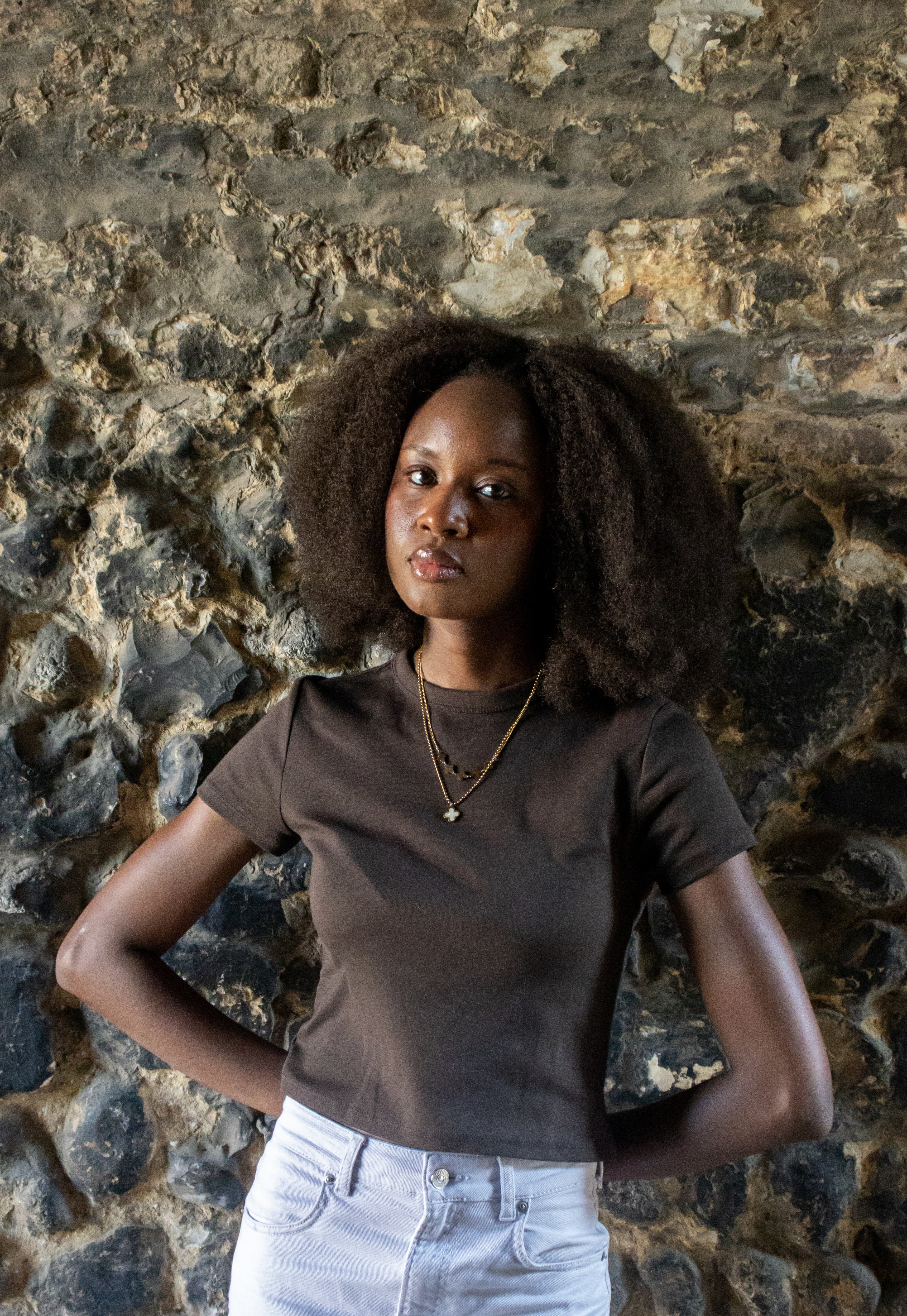

Emotions As A Creation Tool
“Empathy, imagining what something would feel like to someone else, sometimes I feel it so deeply it makes me emotional, sometimes tearing up. Truly starting to wonder if that’s normal.” She laughs gently after saying it, but there is an honesty in the admission that mirrors the very questions her work invites. It is easy to imagine that this heightened sensitivity is less a burden than it is a way of moving through the world, one that allows her to notice the emotional undercurrents many of us pass by without seeing.That attentiveness extends into every part of her practice.
Luchong works across painting, sound and storytelling, yet she doesn’t see them as separate disciplines. Instead, they exist in quiet conversation with one another.“They all feed into each other, one inspiring the other and supporting each other” she says.
It is a deceptively simple explanation for what is, in reality, an intricate creative process. Luchong allows them to become companions, each helping the other express what one alone cannot fully articulate.When asked where an artwork usually begins, she resists choosing a single starting point.“All of these to be honest, but mostly a feeling as sometimes feelings are driven by memory or a question. Another key thing for me is human poses and soft/still gestures, many of which come from just observing people.” Feelings, memory, questions, observation, each becomes another thread woven into the fabric of her work.


Perhaps that explains why her paintings never feel overly prescriptive. They don’t arrive with fixed conclusions or demand a singular interpretation. Instead, they offer emotional possibilities, inviting viewers to meet them from wherever they happen to be. That openness becomes particularly evident in the way she constructs her figures. At first glance, the gaze often captures attention. It lingers, quietly holding the viewer in place. Yet for Luchong, the face is only one part of a much larger emotional language.”I believe people are their true selves in the quiet, there you can feel, have conversations with yourself and get to know the real you.” That is a philosophy that shifts the way we encounter her work. Rather than searching for dramatic expressions or theatrical displays of feeling, she is drawn to moments of stillness, where emotion settles naturally into posture, gesture and presence.

When asked what she hopes viewers notice beyond the face itself, her answer is immediate.“The Body Language of my figures.”
It is a subtle but significant distinction. The body often tells stories the face cannot. A slight curve of the shoulders, the position of folded hands, the direction of a gaze, the distance between one gesture and the next.These details become emotional vocabulary, allowing the paintings to communicate without relying on obvious symbolism or narrative. Her subjects themselves are equally open-ended, they are not portraits of particular individuals, nor are they fictional characters in the traditional sense.The paintings become less about representation and more about reflection; that same openness shapes Luchongs’ understanding of vulnerability.
In recent years, the word has become increasingly common in conversations around creativity, leadership and mental health. Yet it is often spoken about in abstract terms, as though vulnerability were simply another admirable quality to aspire towards.When the conversation turned to vulnerability, Luchong offered a definition that felt both deeply personal and quietly expansive.

“The bravery and confidence to understand and process emotions without feeling the need to suppress, hide, or deny them altogether, and to be able to show them without shame or fear of judgment,” She said
Rather than reducing people to labels or fixed categories, Luchong is drawn to something far more fluid: the emotional currents that shape our experience of ourselves and one another. When I asked how her understanding of identity as something complex and ever evolving influences the stories she chooses to tell through her work, she gently steered the conversation away from definitions and toward feeling. “For me, it’s not about boxing people into a single identity,” she explained.
Instead, her practice is rooted in the textures of emotion and in capturing what it means to inhabit a particular moment in time. In doing so, her work invites viewers to look beyond the certainty of labels and to sit with the shifting, deeply human experiences that so often exist beneath them. Less about who we have always been than who we are becoming.
It is perhaps fitting, then, that one emotion continues finding its way into her paintings whether she intends it or not.
Strength!Not the triumphant, heroic kind that often dominates public imagination, but the quieter form that reveals itself in ordinary acts of endurance.

When I asked whether there is an emotion she finds herself returning to in her work, even when she is not consciously trying to, Luchong answered without hesitation: “Strength.”
She went on to explain, “The best part for me is that despite the things we carry and feel, we still find the strength to keep going.”
It is this quiet resilience, this enduring capacity to move forward in the face of difficulty, that surfaces again and again throughout her practice. It is impossible to spend time with her work without sensing that belief.
Her figures are rarely untouched by emotion. They hold tenderness, reflection, longing and, at times, uncertainty, yet they never seem defeated. Instead, they suggest that it is possible to feel deeply and continue moving forward, that acknowledging pain need not mean surrendering to it, and that softness and resilience are not opposing forces but quiet companions.

Luchong described the exchange between herself and the finished piece with characteristic openness: “The feel of my finished work often stirs an emotion in me. I usually have an emotion driving a painting, but it’s as though the finished painting gives physical visibility to that feeling and adds more to it. It’s one thing to think of an idea in my head, and to actually see it made. The combination of these emotions births a melody in my head.”
The conversation does not end with the image. It deepens, finding new expression in sound and allowing the emotional life of the painting to continue unfolding long after the paint has dried.It is a striking way of describing creation.
Leave a Reply